A few years ago, I found out one of my best friends was getting married in Greece.
She told us with less than 10 months to plan for this, she asked me to be a bridesmaid, and I needed to get to Europe fast.
I could not find a direct flight to Greece that worked with my points. So instead of panicking, I did what anyone deep in the points and miles game learns to do: I got flexible.
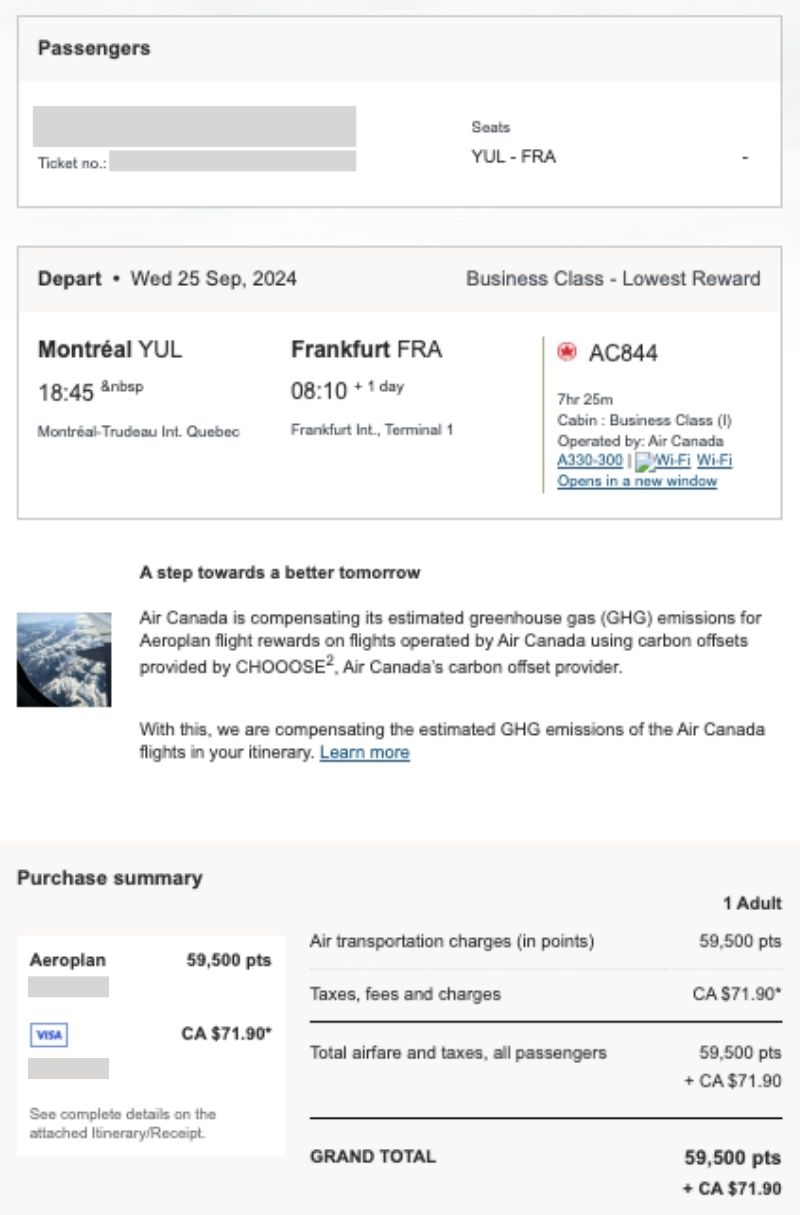
I booked a one-way business class flight from Montreal to Germany on Air Canada for
59,000 Aeroplan points and $79 in taxes and fees.
From Germany, I booked a cheap economy flight to Greece in cash because the fare was inexpensive and it did not make sense to waste points on it.
The Air Canada business class flight alone would have cost approximately
$4,000 in cash.
I paid less in taxes and fees than most people spend on a nice dinner out.
If you’ve ever opened Aeroplan, searched for a flight, and thought, “Why are the points prices so high?” or “Why does everyone else seem to find amazing redemptions and I only see terrible routes?” you’re not alone.
I used to feel the same way.
I would see those astronomical points prices and think, “This is way too much.” Sometimes I would even back out of the booking process when I saw the screen saying I did not have enough points, because I thought the dollar amounts shown were the taxes and fees.
They were not.
I just did not understand how to read the booking screen yet.
That Greece trip was not a fluke. It was Aeroplan used the way it is designed to be used. And once you understand how the program actually works, this kind of redemption becomes something you can replicate, not a lucky accident.
I spent years as an investment advisor at TD Canada Trust, helping hundreds of clients understand credit products and financial decisions. But even working inside a bank, this was knowledge I had to figure out myself.
Most people never do, which is exactly why I am writing this post.
This guide will show you
how to use Aeroplan points, what they are actually worth, how to book a flight step by step, and the F.L.Y. Method I use to consistently find better redemptions without spending more points than I need to.
By the end, Aeroplan should feel less like a confusing points maze and more like a tool you actually know how to use.
My approach comes down to three things:
Flex your window. Lay your route. Know your currency.
That is the F.L.Y. Method, and it is what helps turn Aeroplan from “I have points but no idea what to do with them” into “I know exactly what kind of trip I’m building toward.”
Before you start earning, transferring, or redeeming points blindly, I recommend using the
First Class Calculator to estimate how many points your dream trip may actually require.
How to Use Aeroplan Points Step by Step
Here is the simplest version of how to use Aeroplan points.
The best use of Aeroplan points is usually flights, especially international business class flights on Air Canada or Star Alliance partner airlines.
Here is the basic process:
- Log into your Aeroplan account.
- Search for flights using points, not cash.
- Look for
Lowest Reward options.
- Compare the points cost and taxes against the cash price.
- Choose the flight that gives you strong value.
- Pay the taxes and fees.
- Complete the booking and receive your confirmation.
Beginner translation: you are looking for flights where the cash price is high, but the points price is low.
A $300 flight that costs 25,000 points is usually not exciting.
A $4,000 business class flight that costs 59,000 points and $79 in fees is a very different story.
That is why learning how to search properly matters so much.
What Are Aeroplan Points Actually Worth?
This is the question most people ask first, and it is also the wrong question — at least the way most people are asking it.
When people ask what a point is worth, they are usually looking for a fixed number.
One cent per point. Two cents per point. Some tidy conversion rate they can apply universally.
The problem is that Aeroplan does not work that way, and that is actually the whole reason it is worth using.
Aeroplan points do not have a fixed value. They have a variable value that depends entirely on what you redeem them for.
Redeem them for a gift card or merchandise and you will usually get somewhere around one cent per point.
Redeem them for a business class flight on a partner airline at the right time through the right routing, and you can extract five, eight, sometimes ten cents of value per point or more.
That gap is the entire game.
Here is a simple way to think about it.
A one-way business class flight from Toronto or Montreal to Europe can retail for around $4,000 in cash.
I booked that same type of flight for 59,000 Aeroplan points.
Divide $4,000 by 59,000 and you get approximately
6.8 cents of value per point.
Compare that to redeeming 59,000 points for gift cards at one cent each, which would give you around $590.
It's the same points but the way you use it drastically changes your outcome.
Beginner takeaway: Aeroplan points are only as valuable as the redemption you choose.
Aeroplan uses dynamic award pricing, which means the number of points required for a given flight is not fixed.
It fluctuates based on demand, availability, routing, airline, cabin class, and how far in advance you are booking.
The program publishes general pricing ranges, but the actual price you see when you search can move above or below what you expect depending on conditions.
I have seen business class redemptions come in below the published floor when I was flexible on routing.
I have also seen the same routes priced at 200,000 or 300,000 points during peak periods.
Understanding this dynamic is what separates someone who uses Aeroplan occasionally with mixed results from someone who consistently gets exceptional value from it.
We will get into exactly how to navigate it in the F.L.Y. Method section.
Aeroplan gives you several redemption options.
You can redeem Aeroplan points for flights, hotels, car rentals, merchandise, gift cards, and more.
I am going to be straight with you about all of them.
Flights are where the value is. Full stop.
Every other redemption option in this program is, at best, a convenient use of leftover points. At worst, it is a significant waste of what you have accumulated.
Here is why.
When you redeem Aeroplan points for a flight, you are not paying the cash price in points. You are accessing an award rate that is deliberately disconnected from the retail price of the ticket.
That is the mechanism that allows 59,000 points to cover a $4,000 flight.
That gap between the cash price and the points price is where the outsized value lives, and it mostly exists in the flights category.
When you redeem for gift cards, merchandise, or hotel stays through the Aeroplan rewards store, you are usually getting around one cent per point in value.
You are taking a variable-value currency and locking it into a low fixed-value redemption.
The math works against you almost every time.
I know this from experience, not just theory.
The very first time I ever redeemed Aeroplan points, I used them for a gift card.
I was young, I was new to the program, and honestly, I did not fully understand what I had. I did not want to deal with taxes and fees on a flight, so the gift card felt like the smarter choice.
I cringe thinking about it now.
Not because it was a catastrophic mistake, but because I had points that could have covered a flight and I traded them for something that wasn't worth much to me.
Do not be me circa my early bank days.
I have also used Aeroplan points for Wi-Fi on a flight before.
At the time, it felt harmless because it was a small redemption. But now, I would not do that.
Due to my current spending habits, I am not sitting on an unlimited pile of Aeroplan points, so I want every point to move me closer to a flight. A little Wi-Fi redemption here and a gift card there may not feel like a big deal, but those small choices add up.
Now I exclusively use my Aeroplan points for flights.
Beginner takeaway: if you are not in an abundance of Aeroplan points, do not drain them on small convenience redemptions. Save them for flights where they can do the most work.
Hotels through Aeroplan are slightly more nuanced.
There are occasionally decent redemptions available, and if you are truly swimming in points and a specific hotel deal makes sense, it is not always a terrible choice.
But in general, for most people building toward premium travel, every point you spend on a hotel redemption through Aeroplan is a point that is not getting you into a lie-flat seat over the Atlantic or Pacific.
I am laser focused on flights.
That is what this program was built to deliver at its highest level, and that is where I direct every client who comes to me with an Aeroplan balance.
How to Book a Flight With Aeroplan Points
The actual booking process is more straightforward than most people expect.
Here is how it works step by step.
Step 1: Know Your Balance Before You Search
Sign in your Aeroplan account through
Air Canada and check your points balance.
This matters before you search because what you see on the booking screen looks very different depending on whether you have enough points or not.
If you know you have 40,000 points and the flight you want costs 70,000 points, you already know you are short before you reach checkout.
That helps you avoid one of the most confusing screens in the Aeroplan booking process.
Step 2: Search for Reward Flights
You will automatically be taken to the flight search screen on the Air Canada website.
Enter your origin, destination, number of passengers, and travel dates you want.
Select points rather than the cash booking option.
This is where you are searching for award space, which is the inventory Air Canada and its partners make available for points redemptions.
Beginner translation: not every seat on the plane is available to book with points. You are searching for the seats the airline has released for reward bookings.
Step 3: Look for the Lowest Reward Option
When results appear, you may see flights labeled
Lowest Reward.
This is the saver end of Aeroplan’s dynamic pricing range. It tells you that this seat is available at a lower points cost relative to other options on the same route.
Always start here.
A Lowest Reward flight does not mean the seat is worse.
It usually means the availability conditions are more favorable and the points cost is lower.
Step 4: Understand the Checkout Screen
This is where a lot of people get confused and give up, so I want to be specific.
If you have enough points, the checkout screen will show you the points required plus the taxes and fees in Canadian dollars for different options including ones that would allow you to book entirely with points (this is usually the worst option).
For many Aeroplan redemptions, particularly on Air Canada flights, the second last option, which is not covering taxes and fees can be very reasonable.
I have paid as little as $79 in taxes and fees on a transatlantic business class flight.
But if you do not have enough points, the screen changes entirely.
Aeroplan may show you point purchase packages — options to buy the points you are short at various price points.
The dollar amounts attached to those packages can look alarming.
They are not the taxes and fees on the flight.
They are the cost to purchase the points you need to complete the booking.
This screen has scared off more people than I can count.
It does not necessarily mean the flight is expensive or that Aeroplan is broken.
It just means your balance needs to be higher before you search for that specific redemption.
Step 5: Complete the Booking
Once you select your flight, confirm your cabin, and proceed to checkout with a sufficient points balance, the rest of the booking process works similarly to a cash booking.
You will confirm passenger details, review the points and fees breakdown, and complete the transaction.
Your points will be deducted from your balance and you will receive a booking confirmation.
If you have Aeroplan status, an eligible Aeroplan credit card, or certain fare benefits, you may receive extras like preferred seating, free checked bags, or other perks.
When I flew domestically from
Saint John, New Brunswick to Toronto, I was given a seat with more space at no extra charge because of my 25K Aeroplan status, and my checked baggage was covered by my
TD Aeroplan Visa Infinite Card.
Beginner takeaway: your Aeroplan credit card can add value beyond earning points. Benefits like checked bags can make an award booking even more useful, especially on domestic flights where baggage fees add up quickly.
Beginner takeaway: the booking process is simple once you know what the screens mean. The real skill is finding the right flight before you reach checkout.
The F.L.Y. Method: How to Find Better Aeroplan Redemptions
Most people search for award flights the same way they search for cash flights.
Fixed dates. Fixed airports. Fixed route.
Then they wonder why they cannot find availability or why the points cost seems high.
The F.L.Y. Method is the framework I use to consistently find better redemptions.
It is not about gaming the system.
It is about understanding the three variables that actually control what you pay in points, and using them to your advantage.
F — Flex Your Window
L — Lay Your Route
Y — Your Currency
This is the difference between searching “Toronto to Paris on this exact Friday” and searching like someone who knows where the value actually hides.
F — Flex Your Window
The single biggest driver of how many points a flight costs is when you are searching and when you are willing to fly.
Aeroplan uses dynamic pricing, which means the same business class seat on the same route can cost 60,000 points on one date and 200,000 points on another.
Supply and demand determines the price.
High-demand dates, peak travel seasons, and last-minute searches all push the points cost up.
Off-peak dates, less popular departure windows, and searches made well in advance tend to surface the lower end of the range.
This is what saver award pricing refers to.
You want to look for the saver seats. With the Air Canada program, this might be shown with the tag Lowest Reward. But, it doesn't mean it's always a saver seat because it could just mean it's the lowest reward for your search.
You are always hunting for saver seats.
Practically speaking, flexing your window means two things.
First, if your travel dates are not fixed, search across a range of dates rather than locking in one specific day.
The Aeroplan calendar view can help you compare availability and pricing across multiple dates, which makes it easier to spot where lower-cost options cluster.
Second, if you are planning a trip with a fixed event, give yourself as much lead time as possible.
For my Germany redemption, I booked on
April 3, 2024 for a
September 25, 2024 departure.
That gave me time to find a strong redemption before the trip.
Award space for popular routes can appear many months in advance, and the best availability often goes early.
Beginner takeaway: if your dates are flexible, your points can go much further.
L — Lay Your Route
Where most people leave points on the table is by only searching direct routes between their home airport and their final destination.
Repositioning, which means flying to a different departure city or arriving into a different gateway city than your final destination, can dramatically change the points cost and availability picture.
This is where you can find
sweet spots.
A sweet spot is a specific routing that consistently comes in at the lower end of the award chart.
It is not a one-off lucky find.
It is a pattern you discover through regular searching that you can replicate over and over.
The Montreal to Germany routing is one of mine.
I have found it reliably at the lower end of Aeroplan’s business class range for transatlantic redemptions, often below what a direct Toronto to Germany search returns.
It costs me a short train ride or a cheap domestic flight to get to Montreal, but the points savings can more than justify it.
For my Germany trip, I saved approximately 20,000 points compared to flying direct from Toronto.
Over time, as you search regularly, you start to build a personal map of which routings work repeatedly in your favor.
That is your sweet spot toolkit.
Beginner takeaway: you are not locked into your home airport. Sometimes a short positioning flight or train ride can unlock a much better redemption.
The stopover strategy takes this one step further.
Aeroplan allows stopovers on certain eligible award bookings, meaning you may be able to stop in one city for multiple days before continuing to your final destination, all on the same booking.
This is how I flew to Switzerland and then Singapore on a single Aeroplan booking, covering two separate destinations and two exceptional airline products — Swiss Airlines and Singapore Airlines — for roughly 92,500 points and around $232 in taxes and fees per person.
At time of writing, Aeroplan stopover rules and fees can vary by itinerary, so always confirm the current terms before booking.
The key principle behind L is this: you are not locked into the obvious route.
The more willing you are to approach your destination creatively, the more options open up and the lower the points cost tends to be (unless you have so much points and don't fly regularly or you have lots of expenses that you accumulate an abundance of points, many business owners with high operating costs are in this category or those that travel infrequently like once every couple of years).
Y — Your Currency
Not every point is equally useful for every redemption.
The Y in F.L.Y. is about making sure the points currency you are building toward can actually get you the flights you want before you accumulate tens of thousands of points in the wrong program.
For Aeroplan redemptions, you are primarily earning through Aeroplan co-branded credit cards or transferring in from programs like American Express Membership Rewards that partner with Aeroplan.
Both can work.
The
right choice depends on your spending patterns, your travel goals, and which other programs you may be building at the same time.
This is where the
First Class Calculator becomes useful.
Before you start earning randomly, use the calculator to estimate how many points your dream trip may require.
That way, you are not collecting Aeroplan points blindly and hoping they will be enough later.
You can work backward from the trip you actually want.
Personally, I like to stay above
two cents per point when deciding whether an Aeroplan redemption is worth it.
That does not mean I obsess over the cents-per-point calculation on every single booking. Sometimes the value is also in flexibility, convenience, or avoiding a painful cash fare.
But as a general rule, if a redemption gives me less than two cents per point, I am probably not booking it.
Beginner translation: do not use points just because you have them. Use them when they save you meaningful money or unlock a flight you would not reasonably pay cash for.
Where this gets strategic is when you are close to a redemption but short on points.
Buying Aeroplan points outright can make sense in specific circumstances:
- when there is a bonus promotion running,
- when you only need a top-up,
- and when the total cost of buying the missing points plus taxes and fees still comes out to a meaningful discount against the cash price of the flight.
I have bought points during an 85 percent bonus promotion to top up for a specific trip, and the math worked clearly in my favor.
The calculation is straightforward:
Total cost of buying the missing points + taxes and fees vs. cash price of the same seat.
If the discount is significant, it may be worth considering.
Outside of bonus promotions, buying points at the base rate rarely makes sense.
The math usually does not work.
Wait for the promotion or earn the remainder through your cards.
Beginner takeaway: do not buy points just because you are short. Buy points only when the math clearly beats paying cash.
Aeroplan Taxes and Fees: What You Are Actually Paying
This is the section I wish existed when I was starting out, because taxes and fees are the number one reason people talk themselves out of Aeroplan redemptions they should absolutely be making.
Let me be direct.
I paid
$79 in taxes and fees to fly business class from Montreal to Germany.
I paid
$119.86 to fly round trip from Saint John, New Brunswick to Toronto when the same flights were going to cost me $1,300 in cash.
I paid approximately
$232 per person in taxes and fees to fly myself and my grandmother to Switzerland on Swiss Airlines and then to Singapore on Singapore Airlines, covering two countries and two of the best airline products in the world on a single booking.
None of those numbers are typos.
The confusion around taxes and fees comes from two places.
The first is that people mix up the taxes and fees on an award booking with the point purchase screen described earlier.
Those are two completely different things.
If you see a screen showing you a large cash amount next to a points amount, you may be looking at the cost to buy points you do not have yet, not the taxes on the flight.
Once you have enough points and you proceed to a standard award booking, the dollar amount you see is the actual government taxes, airport fees, and any carrier surcharges on that specific flight.
The second source of confusion is carrier surcharges, which vary depending on which airline is operating the flight.
Some flights and partners have lower fees. Others may have higher fees.
This is one reason why routing matters beyond just points cost.
The L in F.L.Y. is not only about finding lower point prices. It is also about being aware of which partners add significant fees and factoring that into your decision.
The practical framework I use is simple.
Before any redemption, I look at three numbers:
- How many points the flight costs.
- What the total dollar amount in taxes and fees is.
- What the same flight would cost in cash.
If the points cost plus fees represents a significant discount against the cash price, it is a good redemption.
Here is how that math looked on my Germany trip:
59,000 points + $79 in fees vs. a one-way cash price of approximately $4,000.
There was no version of that math where paying $79 was not the right answer.
Beginner takeaway: do not let taxes and fees scare you away from a good redemption. Run the math first.
In almost every premium cabin international redemption I have booked, the fees have been tiny compared to the cash price of the seat.
At time of writing, taxes, fees, and carrier surcharges can vary by airline, route, and booking rules, so always review the final total before you book.
Award Booking Cancellation: A Hidden Advantage
This is one of the most practical benefits of booking flights with points, and almost nobody talks about it.
When you book a base economy cash fare with Air Canada or most major airlines, you are often looking at a non-refundable ticket after the 24-hour cancellation window.
If your plans change, you may lose the money.
Higher fare classes like Flex offer more change and cancellation flexibility, but you pay a premium for that privilege upfront.
Award bookings can work differently.
When you cancel an Aeroplan award booking, you generally get your points back. There may be a cancellation fee, but your points are usually returned to your account.
I experienced this firsthand when I was planning a trip to Thailand.
I had booked a flight from St. John, New Brunswick to Montreal for
15,000 points and $59.18 in fees to connect to my international flight.
The trip fell through.
I cancelled the booking, paid
$172.50 in cancellation fees including tax, and got my points back.
Net cost to cancel:
$113 after subtracting the original fees I had already paid.
On a $900 cash ticket, the same cancellation likely would have cost me the entire fare.
Instead, I paid $113, kept my points, and those points were available for the next redemption.
Beginner takeaway: points bookings can give you flexibility that cheap cash fares often do not.
This flexibility has real financial value that most people never factor into the cost comparison between cash bookings and award bookings.
When you are deciding whether to use points or pay cash for a trip that has any uncertainty around it, the cancellation flexibility of an award booking can be a meaningful advantage.
One caveat: cancellation policies can change and vary depending on the fare rules of the specific airline, partner, or booking type involved.
Always check the cancellation terms at the time of booking rather than assuming.
Real Aeroplan Redemptions and What They Actually Cost
I have given you the framework.
Now let me show you what it looks like in practice with real numbers from real bookings.
Montreal to Frankfurt, Germany — Business Class, One Way
Year: 2024
Booked: April 3, 2024
Departure date: Wednesday, September 25, 2024
This is the bridesmaid trip.
My best friend’s wedding was in Greece and I needed to get to Europe fast with limited notice.
Route: Montreal to Frankfurt
Carrier: Air Canada
Cabin: Business class
Points: 59,000
Taxes and fees: approximately $79
Cash price: approximately $4,000
Value per point: approximately 6.7 cents
Beginner lesson: Flexible airports can unlock better redemptions.
This came in at a strong Aeroplan business class redemption because of routing flexibility.
Montreal rather than Toronto.
Frankfurt rather than a Greek airport.
From Germany, I booked a separate economy flight to Greece in cash because it was cheap and did not justify using points.
That flexibility saved me points and found me availability that did not exist on the more obvious direct search.
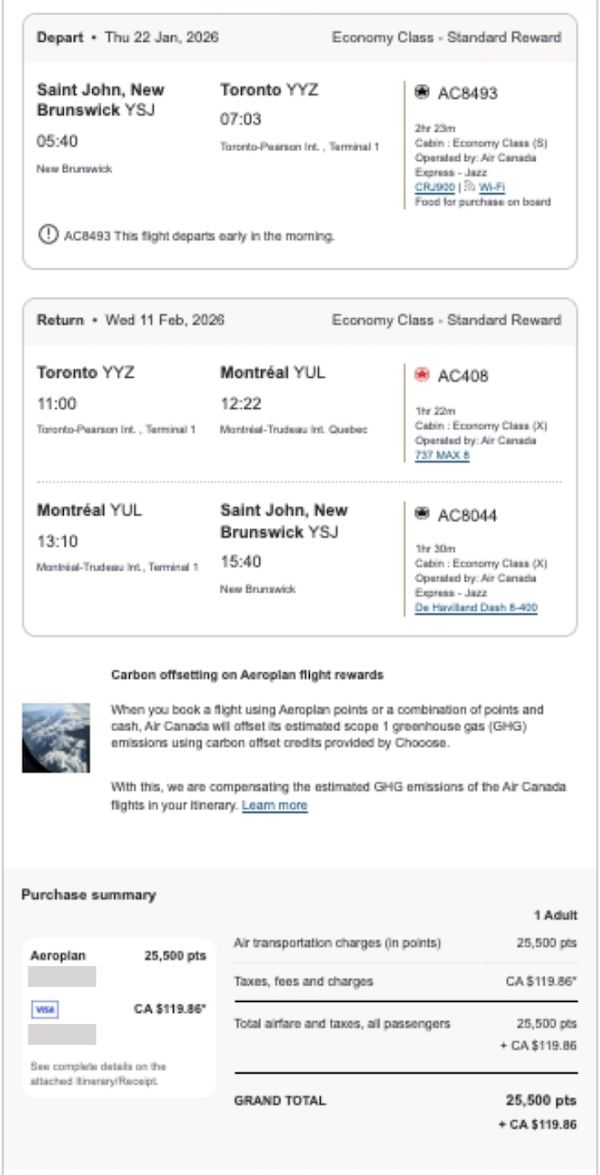
Saint John, New Brunswick to Toronto — Economy, Round Trip
Year: 2026
I do not typically use Aeroplan for domestic travel.
This was an exception born out of stubbornness.
The cash price for a round trip was $1,300, which I could not justify paying.
Route: Saint John, New Brunswick to Toronto, Ontario
Cabin: Economy
Points: 25,500
Taxes and fees: $119.86
Cash price: $1,300
Card benefit: checked bag covered by my TD Aeroplan Visa Infinite Card
Status benefit: complimentary seat upgrade with more space due to my 25K Aeroplan status
Beginner lesson: Not every good redemption has to be aspirational business class. Sometimes a good redemption is the one that saves you real cash when prices are ridiculous.
This was not my most glamorous redemption.
But it saved me over $1,100 in cash at a time when that mattered.
That is the point of having a points balance.
It gives you options.
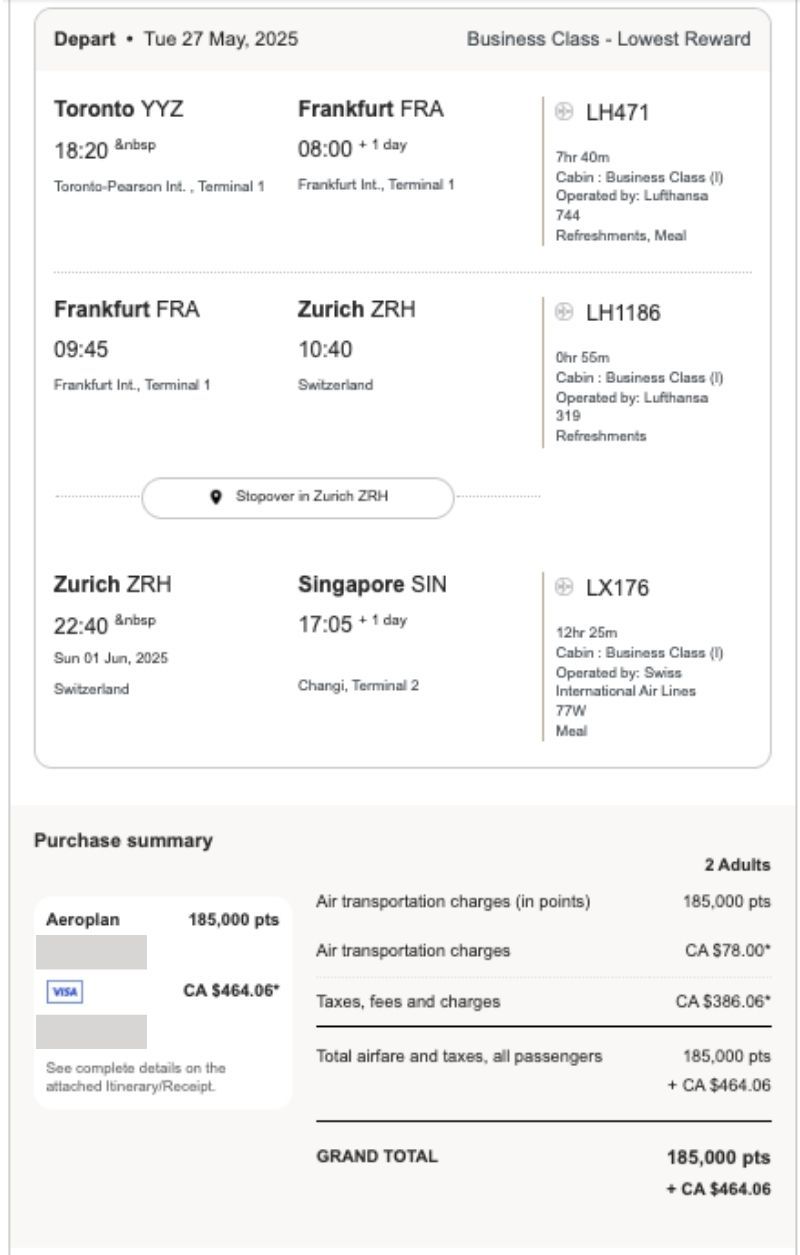
Toronto to Zurich to Singapore — Business Class Stopover Booking
Year: 2025
This is the one that always makes me smile.
I used the Aeroplan stopover program to book a single award that covered two completely separate destinations.
I flew from Toronto to Zurich on Swiss Airlines, spent several days in Switzerland, then flew from Zurich to Singapore on Singapore Airlines, and returned home from Singapore.
Two countries.
Two world-class airline products.
One booking.
And I covered the entire thing for my grandmother and myself.
Route: Toronto to Zurich to Singapore
Cabin: Business class
Points: 185,000 for two people (92,500 per person)
Taxes and fees: $464.06 for two people, ($232 per person)
Airlines: Swiss Airlines and Singapore Airlines
Experience: Swiss lounge access in Zurich, including shower facilities, and business class to Singapore
The Pattern Across All of These Redemptions
Every redemption above followed the same logic.
Know your balance before you search.
Use the F.L.Y. Method to find better availability and lower points costs.
Run the math against the cash price.
Book when the value is clear.
None of these required me to be a points expert with a spreadsheet for every transaction.
They required me to understand the program well enough to search smartly and be willing to flex on routing when the better option was available.
A Good Beginner Aeroplan Redemption to Aim For
If you have between
50,000 and 75,000 Aeroplan points, you have more options than you probably think.
You do not need to start with a complex stopover booking.
You do not need to become an award travel expert overnight.
At that points level, a good beginner goal could be a
one-way business class flight to Europe, especially if you are flexible with your dates, departure airport, or arrival city.
With the right timing and availability, that could mean destinations like Switzerland, Germany, Spain, or Italy.
If you are looking at economy instead of business class, 75,000 Aeroplan points may be enough for a round-trip economy flight to Europe, depending on your dates, route, and availability.
The key is flexibility.
If you do not want to be flexible with stopovers, be flexible with your dates.
If you cannot be flexible with your dates, be flexible with your airport.
If you cannot be flexible with your airport, be realistic that you may need more points.
Beginner takeaway: you do not need hundreds of thousands of points to start using Aeroplan well. You need a clear goal, a little flexibility, and a basic understanding of what a good redemption looks like.
This is exactly why I recommend starting with the
First Class Calculator.
It helps you figure out whether your current points balance is close to the trip you want, or whether you need to keep earning before you book.
Common Mistakes People Make Redeeming Aeroplan Points
Thinking You Need 200,000 Points to Fly Business Class
This is the most common one, and it keeps people from even trying.
Yes, business class award prices can reach 200,000 or 300,000 points on Aeroplan under peak demand conditions.
But the lower end of transatlantic business class pricing can be much more reasonable when you are flexible.
I flew to Germany for 59,000 points.
The belief that premium cabin travel always requires a massive points balance is the belief that keeps people in economy indefinitely.
Backing Out When You See the “Not Enough Points” Screen
This was one of my early mistakes.
I would search for a flight, get excited, click through, and then see a screen showing a large dollar amount because I did not have enough points.
I thought that number was the taxes and fees.
So I would back out and assume Aeroplan was too expensive or the points they showed me on previous screens were somehow a lie.
But that screen was not showing me the cost of the flight taxes.
It was showing me the cost to buy the missing points.
That is a huge difference.
Beginner takeaway: if the dollar amount looks outrageous, check whether you are looking at taxes and fees or a point purchase package.
Not Knowing What a Good Redemption Looks Like
When I first started, I did not have a clear benchmark.
I did not know when I was getting good value versus wasting points.
So I would see high points prices and assume that was normal. Or I would avoid booking because I was scared of making the wrong choice.
Now, I generally want to get at least
two cents per point in value.
For premium cabin international flights, I often get much more than that.
You do not need to calculate the value obsessively every time, but having a rough benchmark helps you make better decisions.
Treating Aeroplan Like Other Rewards Programs
I was used to programs like TD Rewards, where points can feel more like a direct cash substitute.
You use points, they cover the cost, and the math feels simple.
Aeroplan is different.
Aeroplan is not at its best when you treat points like cash.
It is at its best when you use points to access award pricing that is disconnected from the retail price of the ticket.
That is how you get a $4,000 business class flight for 59,000 points and $79 in fees.
Redeeming for Gift Cards, Wi-Fi, Merchandise, or Non-Flight Rewards
Your Aeroplan points are worth dramatically more when used for flights than for most other redemption options.
I have redeemed for a gift card before.
I have also used points for Wi-Fi on a flight.
I would not do either now.
Those redemptions were not the end of the world, but they were not the best use of the points.
Now I save Aeroplan points for flights because I know that is where they can deliver the most value.
Searching With No Flexibility and Concluding Nothing Is Available
A fixed origin, fixed destination, fixed date search that comes back with 300,000 points or no availability is not evidence that Aeroplan does not work.
It is evidence that those specific parameters are expensive or sold out.
Apply the F.L.Y. Method.
Change the departure city.
Adjust the dates by a few days.
Try an alternate routing.
The availability picture often changes completely.
Not Booking Early Enough for Inflexible Trips
If your dates are fixed because of a specific event, early searching matters.
For my Germany redemption, I booked on
April 3, 2024 for a
September 25, 2024 departure.
That gave me time to find a strong redemption before the trip.
Award space on popular routes can appear many months in advance, and the best availability at the lowest points cost often disappears quickly.
Staying in the Wrong Program for Your Goals
If the flights you want are not accessible through Aeroplan or its partner airlines, accumulating Aeroplan points for years may not get you where you want to go.
Know which program gives you access to the specific airlines, routes, and cabin products you want before you decide where to focus your points.
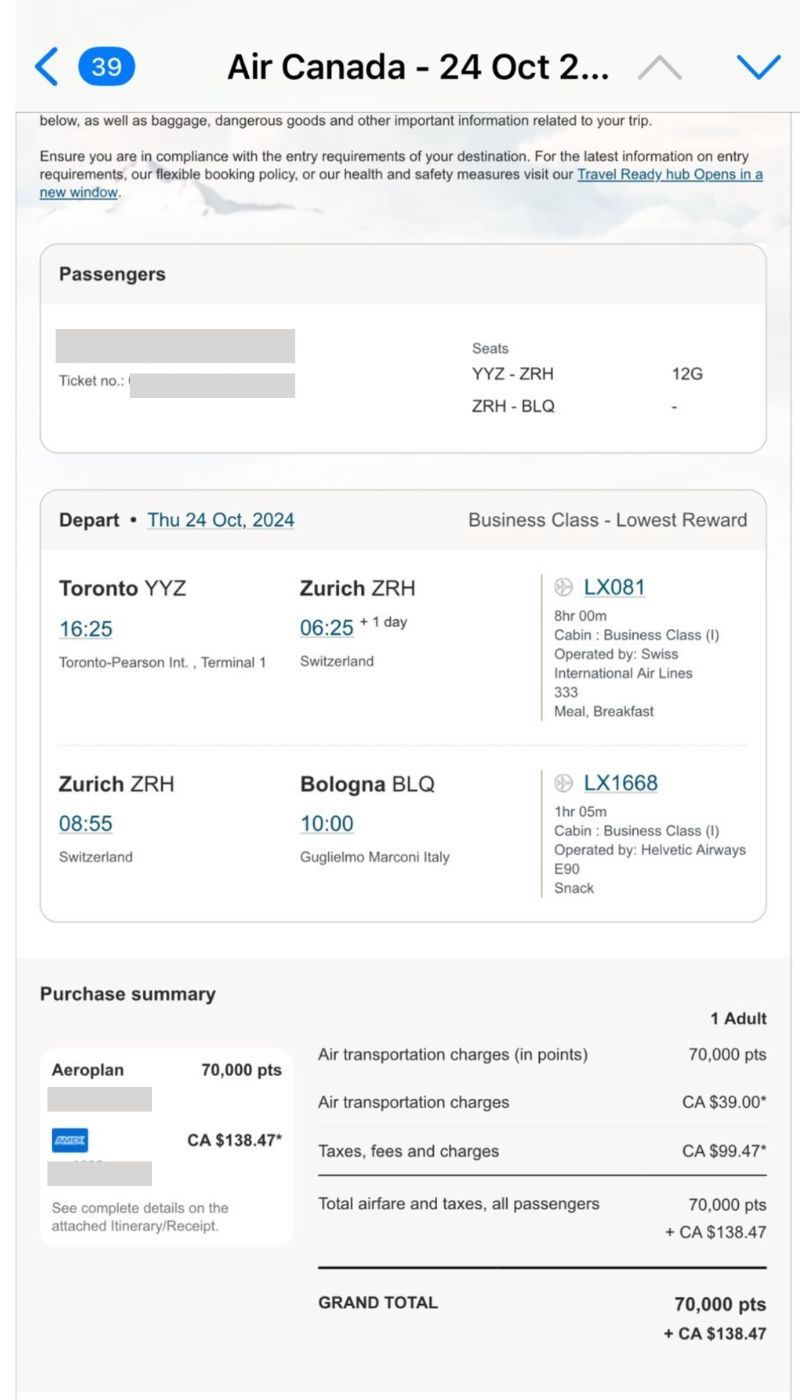
Client Example: Using Aeroplan Points for Italy
I have also helped clients apply this same strategy to their own trips with my
Dream Flight Consulting service.
One client booked an international Aeroplan redemption to
Bologna, Italy after we worked through their points balance, route options, and flexibility.
That is the part I want beginners to understand: this is not just something that worked once for me.
When you understand how Aeroplan pricing, routing, and flexibility work together, you can start applying the same process to completely different destinations.
Common Questions About Using Aeroplan Points
How Many Aeroplan Points Do You Need for a Flight?
It depends on the destination, the cabin, the dates, the airline, and how flexible you are willing to be.
For economy flights within North America, redemptions can start much lower than international premium cabin flights.
For business class to Europe, the lower end can be around the 60,000-70,000 point range, but prices can move much higher based on demand and availability.
For business class to Asia, expect a higher range.
The best way to know what your specific trip requires is to search on the Aeroplan website with the routing and flexibility you have available.
You can also use the
First Class Calculator to work backwards from your dream trip before you start accumulating points.
Can You Use Aeroplan Points for Hotels?
Yes, Aeroplan allows you to redeem points for hotel stays through its travel rewards portal.
However, the value per point on hotel redemptions is usually significantly lower than on flight redemptions.
For most people building toward premium travel, flights are the better use of your Aeroplan balance.
If you are sitting on a very large balance and a specific hotel deal makes mathematical sense, it is worth evaluating.
But do not let hotel redemptions become a habit that drains points you could have used for flights.
Do Aeroplan Points Expire?
Aeroplan points do not usually expire as long as your account has qualifying activity within the required activity period.
Qualifying activity may include earning points through a credit card purchase, shopping through the Aeroplan eStore, flying with Air Canada or a partner airline, or completing other eligible partner transactions.
At time of writing, Aeroplan’s inactivity period is 18 months, but you should always confirm the current policy in your account.
Beginner takeaway: do not let your account sit untouched. One small qualifying activity can help keep your points active.
Can You Use Aeroplan Points on Partner Airlines?
Yes, and this is one of the most powerful features of the program.
Aeroplan gives you access to flights on Air Canada and many partner airlines, including airlines within the Star Alliance network.
That can include airlines like Lufthansa, Swiss Airlines, Singapore Airlines, United Airlines, Turkish Airlines, ANA, TAP Portugal, and more, depending on availability and current partner rules.
You can often book partner airline flights directly through the Aeroplan website the same way you would book an Air Canada flight.
This is how I flew to Germany, Zurich, and Singapore using Aeroplan points.
What Is a Good Aeroplan Redemption?
A good Aeroplan redemption is one where your points save you meaningful money compared to the cash price of the same flight.
Personally, I like to stay above
two cents per point.
To calculate this, divide the cash price of the flight by the number of points required.
For example, if a flight costs $4,000 in cash or 59,000 Aeroplan points, that gives you approximately 6.8 cents per point before factoring in taxes and fees.
That is a strong redemption.
But value is not only about the math.
Sometimes a good redemption is the one that saves you from paying a painful cash fare, gives you flexibility, or lets you take a trip you otherwise would not take.
As a general rule, I would avoid using Aeroplan points for low-value redemptions like gift cards, merchandise, or small convenience purchases unless you truly have no better use for them.
What Is the Best Way to Redeem Aeroplan Points?
The best way to redeem Aeroplan points is usually international flights, especially business class flights on Air Canada or partner airlines.
That is where the value gap between points cost and cash price is often the largest.
Apply the F.L.Y. Method:
Flex your window. Lay your route. Know your currency.
That will help you find redemptions that deliver far more value than gift cards, merchandise, or low-value travel redemptions.
Start with the
First Class Calculator to know what you are working toward before you search.
Use Your Points With Intention
Aeroplan is not complicated once you understand what it is actually designed to do.
It is a program that allows you to access flights, especially premium cabin international flights, at a fraction of their cash price.
Everything else it offers is secondary to that core function.
The F.L.Y. Method is how you get there consistently.
Flex your window to find lower award pricing.
Lay your route to uncover sweet spots and stopover opportunities.
Know your currency so the points you are building are pointed at the flights you actually want.
I flew to Europe as a bridesmaid for $79 in fees.
I took my grandmother to Switzerland and Singapore for approximately $232 each in fees.
I flew round trip domestically from Saint John, New Brunswick to Toronto and saved over $1,100 in cash at a moment when that mattered.
I have also helped clients use Aeroplan points for international redemptions, including bookings across North America, Europe, and Asia.
None of this required them being a full-time points expert.
It required understanding the program well enough to search smartly, recognize good value, and stay flexible where it mattered.
That is available to you too.
If you want to know exactly how many points you need for your dream trip before you start building toward it, download the
First Class Calculator.
It will help you work backward from the flight you actually want, so you are not collecting points without a plan.
Ready to start building your Aeroplan balance? Learn how to earn points efficiently.
And if you are still building your foundation on how travel rewards work, start
here.