Most business owners I talk to are sitting on a missed opportunity and they do not even know it.
They are putting hundreds or thousands of dollars of operating expenses through a personal card every month, or worse, through a debit account, earning nothing meaningful back.
Every software subscription, vendor payment, business meal, course, contractor invoice, legal bill, or consulting expense that could have gone on the right card — but did not — is a transaction that built zero travel equity.
I was that person.
At the beginning, I was spending heavily trying to build my business the “right” way. I bought courses, hired consultants, paid for subscriptions, invested in systems, and worked with a lawyer for my trademark. I am a lifelong learner, and I spent a lot of money trying to figure out entrepreneurship before realizing that learning alone was not the same as building.
Those expenses were still real money coming out of my business. Once I started putting them through a dedicated business credit card, they started turning into travel rewards instead of just disappearing from my bank account.
Within my first year, I earned over 100,000 RBC Avion points using a combination of business expenses, a welcome bonus, and a targeted upgrade offer. I later transferred Avion points to British Airways Avios during 30% transfer bonus windows and booked Montreal to Bangkok through Doha, including Qatar Airways Qsuites business class and first class segments.
The flights were worth over $15,000 per person in cash.
That is why business credit card travel rewards in Canada can be so powerful for the right business owner. You are not spending more money to earn points. You are making the money you already spend work twice.
The quick answer: if you are a Canadian business owner with legitimate monthly expenses, a business credit card like the RBC Avion Visa Infinite Business can help you build toward premium travel faster than personal spending alone. The card earns 1.25 Avion points per dollar on the first $75,000 in annual purchases, and when combined with welcome bonuses, upgrade offers, and transfer bonuses, even a business spending $2,000 to $5,000 per month can build a meaningful points balance.
Why Business Credit Card Travel Rewards Work Differently for Business Owners in Canada
The fundamental difference between a personal points strategy and a business points strategy is volume.
A personal card might see $3,000 to $5,000 in monthly spending for a typical Canadian professional. A business card can easily see that same amount — or much more — depending on the business model.
That does not mean you need to run a huge company for this to work.
When I started, I was often putting around $2,000 to $4,000 per month in expenses through my card. That included things like:
- Business courses and education
- Consulting
- Software subscriptions
- Legal work for my trademark
- Business tools and systems
- Professional services
- Recurring operating costs
Those were not extra purchases I made just to earn points. They were expenses I was already paying.
The difference was that instead of letting those expenses disappear through debit or a weak card, I redirected them through a business card that rewarded me properly.
That is the key idea behind business credit card rewards. The spending is already happening. The strategy is choosing where that spending goes.
Why the 1.25x Earn Rate Matters
The RBC Avion Visa Infinite Business card earns 1.25 Avion points per dollar on the first $75,000 in annual purchases, then 1 point per dollar after that.
That accelerated earn rate matters more than it looks at first.
If you maximize the first $75,000 in annual spending at 1.25 points per dollar, you earn:
- $75,000 x 1.25 = 93,750 Avion points
If that same $75,000 earned only 1 point per dollar, you would earn:
- $75,000 x 1 = 75,000 Avion points
That is an extra
18,750 Avion points per year from the accelerated earn rate alone.
The welcome bonus and upgrade offer gave me the initial push, but the 1.25x earning rate helped make my regular business spending more powerful over time.
For business owners comparing the best business credit card for rewards in Canada, this is why the earn structure matters. A card is not just “good” because it has a bonus. It also needs to reward the kind of spending your business actually does every month.
The Mistake I Made Mixing Business and Personal Expenses
Before this strategy became clean, I made a very common mistake: I mixed personal and business expenses.
I used to put some personal spending on my business card because I figured I could sort it out later.
Then later came.
I opened QuickBooks, started going through my transactions, and realized how stressful that system was. Dining was especially annoying because I had to look back and figure out whether a meal was for business, personal, or something I could no longer confidently document.
If I did not have the documentation to support it, I excluded it. That means I may have missed legitimate deductions simply because my bookkeeping was messy.
That was the moment I realized this was not just a points strategy. It was a business systems problem.
I
learned how to
properly manage my bookkeeping and QuickBooks through Chillbooks, and that was when it really clicked for me: unless you are extremely organized and know exactly what you are doing, mixing personal and business expenses creates unnecessary stress.
For most business owners, the cleaner strategy is simple:
- Use a dedicated business card for business expenses
- Use a separate personal card for personal expenses
- Keep documentation as you go
- Do not rely on your future self to remember what happened months later
Your accountant will thank you. Your future self will thank you. And your travel rewards strategy will be easier to track.
How I Earned Over 100,000 RBC Avion Points in My First Year
I did not earn 100,000+ Avion points because I was spending wildly or buying things I did not need.
I earned them because I combined three things:
- A business card welcome bonus
- A targeted upgrade offer
- Regular business expenses I was already paying
That combination is what made the timeline work.
I Started With the RBC Avion Visa Business Card
I originally started with the RBC Avion Visa Business card and earned the welcome bonus available at the time.
I do not remember the exact original bonus amount, and I do not want to guess because welcome bonuses change regularly. The specific offer I received is less important than the strategy.
The welcome bonus gave me a head start.
A few months later, RBC sent me a targeted upgrade offer to move to the RBC Avion Visa Infinite Business card. That upgrade came with
25,000 Avion points and no annual fee increase for the first year, so I took it.
Between the original welcome bonus, the upgrade offer, and my ongoing business expenses, I crossed 100,000 Avion points within my first year.
That is what made me realize how powerful a small business credit card in Canada can be when it is matched to the right spending pattern.
I Put Real Business Expenses Through the Card
After the bonuses, I kept putting eligible business expenses through the card.
For me, that included courses, consulting, subscriptions, legal work, and tools I was using to build the business.
Any legitimate business expense can help build points if it can be paid by credit card and you are not paying fees that erase the value.
I always ask vendors whether credit card payment is an option. If there is a processing fee, I run the math before deciding. A small fee may still make sense if the points are going toward a high-value redemption, but it is not automatic.
The point is not to pay unnecessary fees or spend more money.
The point is to stop letting expenses you already have earn nothing.
What I Would Do Differently If I Started Again
I would separate business and personal expenses sooner — at least in the beginning.
That is the biggest lesson.
When I first started, I was mixing everything together without a strong bookkeeping system. The points were exciting, but the stress of sorting through transactions later was not worth it. If I were starting from scratch, I would make the business card a clean business-only card from day one until my bookkeeping system was solid.
Now, I use a more advanced strategy where I may put certain large, easy-to-identify personal expenses on the card when the accelerated earn rate makes sense. But that only works because I am on top of my bookkeeping, the purchases are obvious lump-sum transactions, and I can clearly separate them from actual business expenses.
Always ask your accountant what makes sense for your business structure. I can share what works for my points strategy and bookkeeping system, but your accountant should be the final word on how to track, categorize, and document expenses properly.
That is not where I recommend most business owners start.
If you are new to business credit cards, new to bookkeeping, or already behind on categorizing transactions, keep it simple: business expenses on the business card, personal expenses on the personal card.
I would also track transfer bonuses earlier.
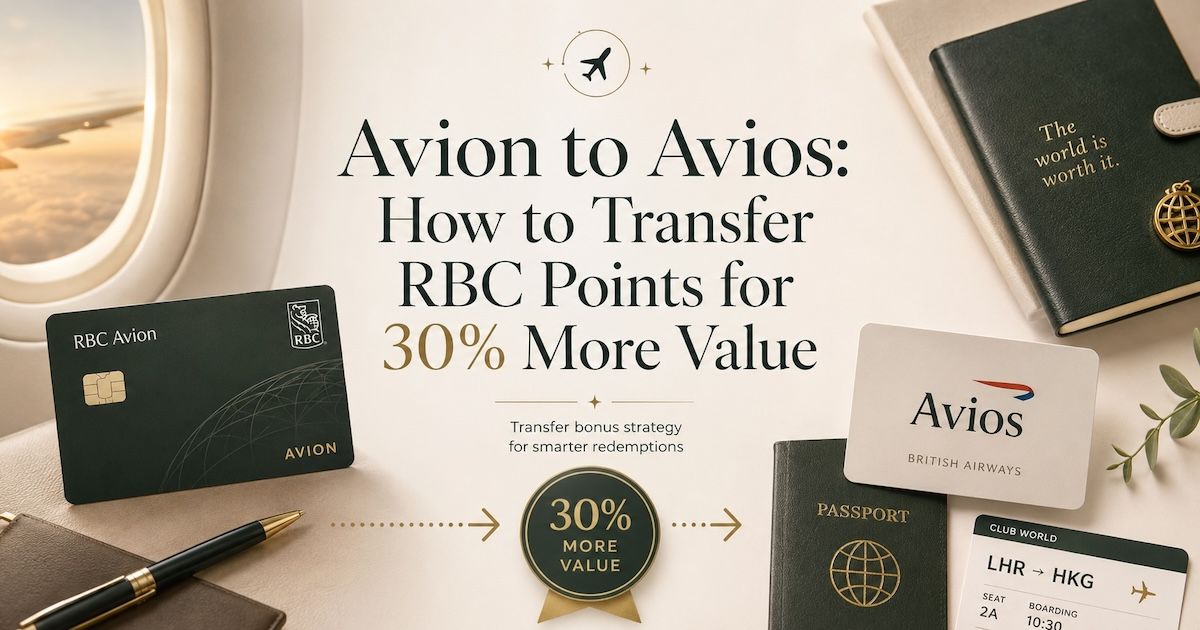
The first time I saw a 30% RBC Avion to British Airways Avios transfer bonus, I missed it because I was unorganized. After that, I started paying attention. Since I have been tracking them, the transfer bonus has appeared roughly twice per year.
That changed how I approached the strategy.
Instead of transferring points the second I had them, I waited for the bonus windows so my Avion points would become more Avios.
For the full mechanics of that process, read
how to transfer RBC Avion points to British Airways Avios.
How I Used Avion Points to Book Qatar Airways Qsuites and First Class
The first time I transferred Avion points to British Airways Avios, I transferred
131,000 Avion points during a 30% transfer bonus.
That transfer became approximately
170,000 Avios.
I had earned over 100,000 Avion points in my first year, which was enough to get me meaningfully close to the one-way redemption I wanted. But the full round trip was a longer-term play.
The routing I eventually booked was:
Departure
- Montreal to Doha in Qatar Airways Qsuites business class
- Doha to Bangkok in Qatar Airways first class
Return
- Bangkok to Doha in Qatar Airways Qsuites
- Doha to Montreal in Qatar Airways Qsuites
Each direction priced at
95,000 Avios, so I needed enough for 190,000 Avios for the round trip.
I timed both of my Avion to Avios transfers around 30% transfer bonus windows so I could stretch the value further.
The card helped me earn the points, but the transfer bonus helped me multiply them.
When the ticket was issued, I honestly felt disbelief.
Qatar Qsuites was one of those aspirational flights I had seen people talk about online. It did not feel like something I would actually book from business expenses I was already paying.
I felt proud because it proved the strategy worked.
What Happened When the Trip Was Cancelled
I did not end up taking the trip.
There were missiles near Doha, and non-essential travel was cancelled. Because my route connected through Doha, I decided not to travel.
This is where the booking program mattered.
Because I had booked through British Airways using Avios, I had to follow British Airways’ cancellation and redeposit rules. If I had cancelled voluntarily, I would have had to pay the Avios redeposit/cancellation fee, which was listed as CAD $58.
Since Qatar cancelled the flights, I waited for the airline cancellation and received a full refund of the Avios plus the taxes and fees.
That experience taught me that award travel strategy is not just about earning points. It is also about understanding:
- Which program you booked through
- The cancellation policy
- Whether you are cancelling voluntarily or the airline cancelled
- What happens to your points and taxes
- Whether you booked one itinerary or separate itineraries
You can review the current policy directly through
British Airways’ reward flight booking and service fees before booking with Avios.
Why the RBC Avion Business Card Worked for My Spending
The RBC Avion Visa Infinite Business card worked well for me because my business expenses were varied.
I was not only spending in one category like gas, office supplies, or travel. I had mixed expenses: courses, subscriptions, consulting, legal fees, software, and systems.
That made a flat earn rate valuable.
The Flat Earn Rate Matched My Business Expenses
The RBC Avion Visa Infinite Business card earns 1.25 Avion points per dollar on the first $75,000 in annual purchases.
For a business owner with varied expenses, that is useful because you do not need to worry about whether each purchase fits into a bonus category.
Courses, subscriptions, legal work, software, consulting, meals, and professional services can all contribute if they are eligible purchases on the card.
The Transfer Partners Made the Points More Valuable
RBC Avion points can be transferred to partners including British Airways Executive Club, American Airlines AAdvantage, Cathay Pacific Asia Miles, and WestJet Rewards.
For me, British Airways Avios was the most important partner because it gave me access to Qatar Airways.
That matters because premium international redemptions often deliver much more value than simple statement credits or portal redemptions.
For the bigger picture of how Avion points work, read
the complete guide to using RBC Avion points.
The Annual Fee Made Sense for My Situation
The RBC Avion Visa Infinite Business card has a $175 annual fee, so it will not make sense for every business owner.
In my case, the welcome bonus, targeted upgrade offer, increased earn rate, and eventual premium redemption made the card worthwhile.
But the fee only makes sense if the math works for your business.
Before choosing any business credit card rewards strategy, ask:
- How much do I spend monthly on legitimate business expenses?
- Can I pay the card off in full every month?
- Do my vendors accept credit card payments?
- Are there processing fees?
- What kind of travel do I actually want?
- Am I willing to learn how transfers work?
The best business credit card in Canada depends on your goals. For my goal — premium international travel through transferable points — the RBC Avion business card was a strong fit.
Who This Strategy Works Best For
This strategy works best for business owners who are already spending at least
$2,000 to $3,000 per month on legitimate business expenses and can pay the card off in full.
It is especially useful if you have recurring or predictable costs, such as:
- Software subscriptions
- Contractors
- Consulting
- Legal or accounting fees
- Business education
- Advertising
- Professional services
- Inventory or supplies
- Business travel
- Client meals
You do not need to be spending $30,000 per month for this to matter.
I was often spending between $2,000 and $4,000 per month when I started. The welcome bonus, upgrade offer, and consistent spending still helped me cross 100,000 Avion points within my first year.
This also works well for business owners who want their expenses to “pay them back” in some way. If you are already investing in your business, a points strategy can help those expenses contribute to something beyond the original purchase.
Who Should Not Use This Strategy
This strategy is not for everyone.
Do not use a business credit card travel rewards strategy if you are:
- Carrying a credit card balance
- Struggling to pay debt
- Having cash flow issues
- Spending more just to earn points
- Unable to separate personal and business expenses
- Too disorganized to track payments and documentation
- Paying high processing fees that erase the value of the rewards
Travel rewards only work when you are paying expenses you already had and paying the card off in full.
If the card creates interest charges, financial stress, or overspending, the points are not worth it.
This is the same rule I use for personal travel rewards, too. Points are only valuable when they come from spending you can afford.
Are Business Credit Card Rewards Taxable in Canada?
This is one of the most common questions about business credit card rewards in Canada.
The short answer is: it depends on how the points are earned, who controls them, how they are redeemed, and your business structure.
The CRA has guidance on
loyalty or other points programs, but much of that guidance focuses on employee benefit situations, such as whether an employer or employee controls the points and whether the points are converted to cash. The CRA notes that some loyalty points may not be taxable under its administrative policy if specific conditions are met, while other arrangements can create a taxable benefit.
That is why I do not treat business credit card rewards as a simple yes-or-no tax question.
I am not a tax advisor, and this is not tax advice. Always ask your accountant how business credit card rewards, business expenses, and personal redemptions apply to your specific situation.
This is another reason clean bookkeeping matters. If your business and personal spending are mixed together, the tax conversation becomes more complicated than it needs to be.
This Strategy Is Not Only for Traditional Business Owners
The same principle can apply to anyone with high legitimate spending, but the details will depend on the person.
Real estate investors, contractors, freelancers, agency owners, consultants, and course creators may all have meaningful business expenses that can run through the right card.
Even major life events can create a similar opportunity. A wedding, for example, can involve $30,000 to $50,000 or more in expenses. If vendors accept credit card payments and the fees make sense, that spending could help fund the honeymoon flight.
The vehicle changes depending on the person.
The principle is the same: make your spending work twice.
There are also strategies for high-income earners who may be able to leverage business cards differently, but that is a separate topic. For this post, the focus is business owners with real operating expenses who want those expenses to build toward travel.
Frequently Asked Questions
Can a business owner earn enough points for a business class flight in under a year?
Yes, depending on their monthly spending, welcome bonus, and card strategy.
I earned over 100,000 Avion points within my first year through a combination of the RBC Avion Visa Business welcome bonus, a targeted upgrade offer to the RBC Avion Visa Infinite Business, and regular business expenses.
A business owner spending $2,000 to $4,000 per month can build a meaningful points balance, especially when welcome bonuses and transfer bonuses are used strategically.
Is the RBC Avion Visa Infinite Business card the best business travel card in Canada?
It depends on your travel goals.
For business owners who want premium international travel and access to partners like British Airways Avios, Qatar Airways, and Cathay Pacific, the RBC Avion Visa Infinite Business card can be a strong option.
But the best business credit card for rewards depends on your spending, desired airlines, ability to use transfer partners, and whether you want premium travel or simpler redemptions.
Do I need a registered business to get the RBC Avion Visa Infinite Business card?
You typically need to demonstrate business income or be self-employed to qualify for a business credit card in Canada.
The requirements vary, and RBC will assess your application based on your business profile. Sole proprietors, self-employed people, and registered business owners may be eligible, but you should review the current requirements before applying.
Can I use RBC Avion business card points for personal travel?
Yes, RBC Avion points earned from a business card can be redeemed for personal travel.
That said, if you are earning points through business expenses, talk to your accountant about how this applies to your business structure and tax situation.
Are business credit card rewards taxable in Canada?
The tax treatment depends on your situation.
In many cases, credit card rewards are not treated like regular income, but business rewards can create more nuance depending on how the points are earned, who controls them, and how they are used. The CRA has guidance on
loyalty or other points programs, but it does not turn every business credit card rewards situation into a simple yes-or-no answer.
Ask your accountant before making assumptions, especially if you are earning points through business expenses and redeeming them for personal travel.
What business expenses can earn travel rewards?
Any expense that can be paid by credit card can potentially earn travel rewards.
Examples include software, courses, consulting, advertising, legal fees, accounting, subscriptions, business travel, meals, equipment, and professional services.
The key is that these should be legitimate expenses you were already going to pay. Do not spend extra money just to earn points.
The Bottom Line
If you are a business owner and your operating expenses are going through debit or a card that earns nothing meaningful, you may be leaving real value behind every month.
I learned this by accident at first.
I was investing heavily in my business, buying courses, paying for tools, hiring experts, and trying to figure out entrepreneurship. Once I put those expenses through a dedicated business credit card, the same spending started building toward travel.
But I also learned the hard way that the system needs to be clean.
Separate your business and personal expenses. Keep your bookkeeping organized. Pay the card in full. Watch for welcome bonuses and transfer bonuses. Choose the card based on the trip you actually want, not just the card that sounds good.
The spending is happening either way.
The only question is whether it is building toward nothing — or helping you get closer to a flat bed seat over the ocean.
Before you apply for a card or start moving points around, figure out what your dream trip actually costs in points. The
First Class Calculator will show you how many points you need for the flight you want.
And if you want help applying this to your own business spending and travel goals, you can
book a travel rewards consult.