Most people spend months dreaming about where they want to go.
But they spend almost no time planning how they’ll earn the Aeroplan points to get there.
That’s why they end up booking too late, using more points than they needed to, or paying cash when a better plan could have helped them avoid it.
The redemption strategy gets all the attention. But your earning strategy is what determines how fast you actually get to book the trip.
I see this all the time with clients. They’re already spending enough to earn meaningful rewards, but their points are scattered across the wrong cards, programs, or habits. They’re not spending too little. Their spending just isn’t working hard enough.
The good news? Earning Aeroplan points faster doesn’t mean spending more money.
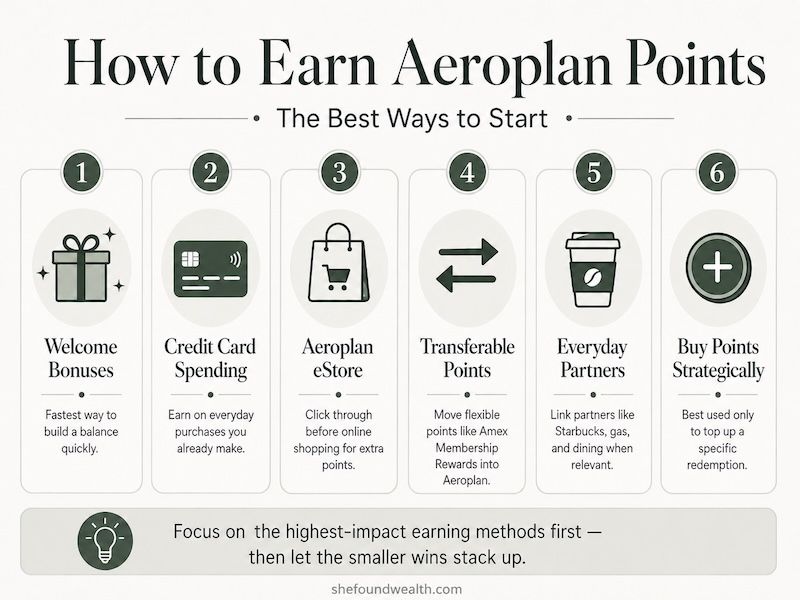
There are five main ways to earn Aeroplan points: credit card spending, welcome bonuses, the Aeroplan eStore, everyday partner programs, and occasionally buying points when the math works.
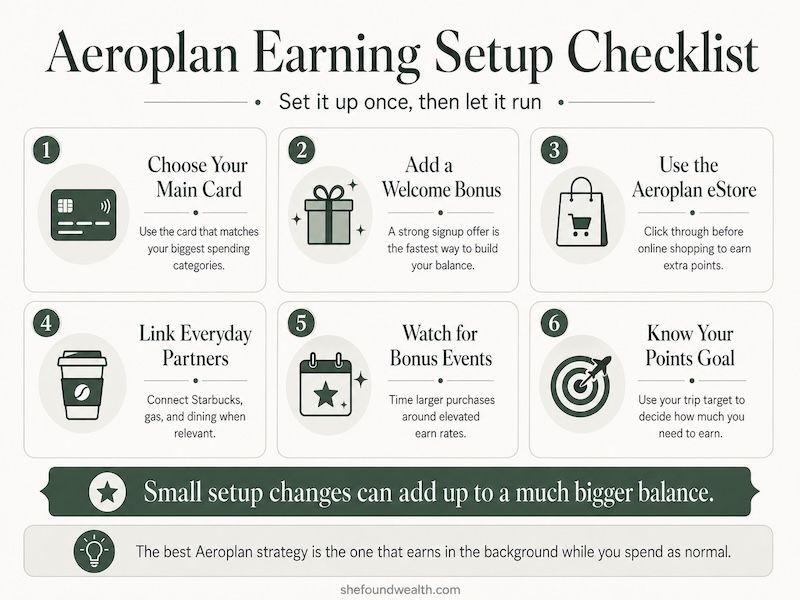
The basic system is simple: choose the right earning card, collect a welcome bonus, route online shopping through the Aeroplan eStore, link everyday partner accounts, and only buy points when it saves you money on a specific redemption.
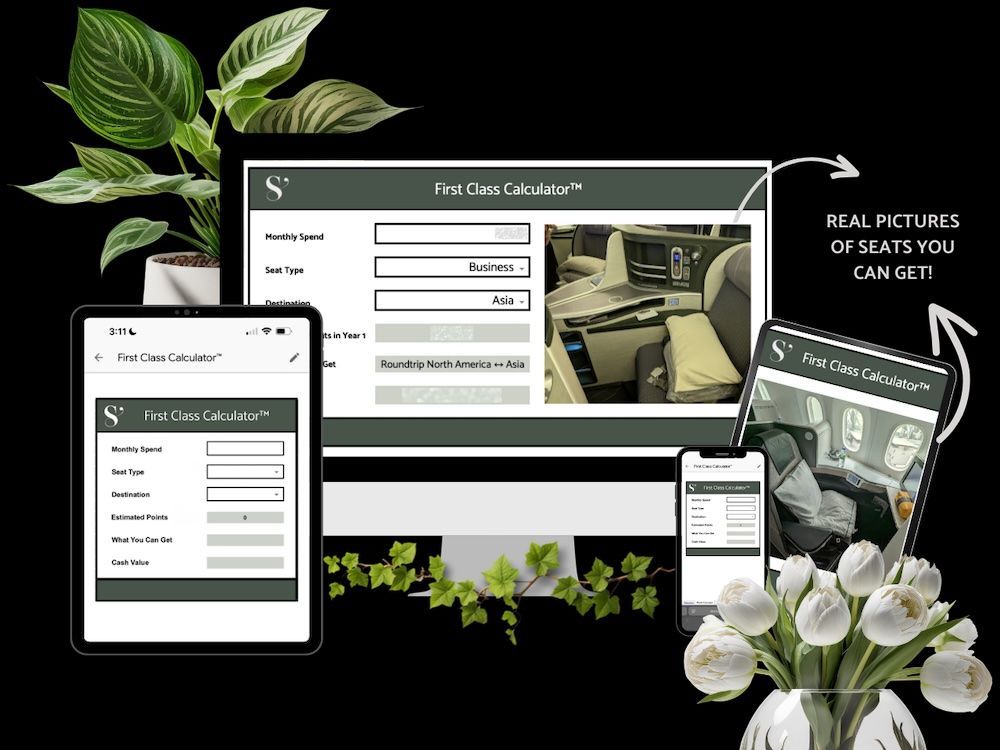
Before you start chasing points, it helps to know your target. If you want to figure out how many Aeroplan points you actually need for your dream trip, download the
First Class Calculator first so you can work backward from a real goal.
In this post, I’ll show you how to build your Aeroplan balance efficiently, including which credit cards do the heaviest lifting, how to use the Aeroplan eStore strategically, and when buying points actually makes financial sense.
And once you’ve built up your balance, you’ll want to make sure you’re
using those points wisely and avoid wasting them.
The Best Ways to Earn Aeroplan Points, Ranked
If you’re new to Aeroplan, the easiest mistake is treating every earning method like it matters equally.
It does not.
Some earning methods can add tens of thousands of points quickly. Others are useful, but only once the bigger pieces are already working.
Here’s the order I would focus on:
- Welcome bonuses
- Everyday credit card spending
- Aeroplan eStore purchases
- Transferable points from programs like American Express Membership Rewards
- Everyday Aeroplan partner programs
- Buying points only when topping up for a specific redemption
- Flying and status bonuses if you already fly Air Canada regularly
This order matters because it keeps you focused on the actions that move your balance fastest without encouraging you to spend more than you planned.
For most people, the biggest wins come from getting the right credit card setup, using the welcome bonus well, and making sure purchases they were already going to make are earning as many points as possible.
IMAGE PLACEMENT: “How to Earn Aeroplan Points” system graphic
Create a simple visual showing the main earning paths:
Credit cards → Welcome bonuses → eStore → Partner programs → Transferable points → Buying points strategically → Flights/status
This should go here because it gives beginners the full roadmap before the detailed sections begin.
Earn Aeroplan Points With the Right Credit Card
For most people, the credit card is responsible for the vast majority of their Aeroplan points balance.
Not the eStore. Not dining partners. Not status bonuses.
The card you swipe every day is where your earning strategy either works or it does not.
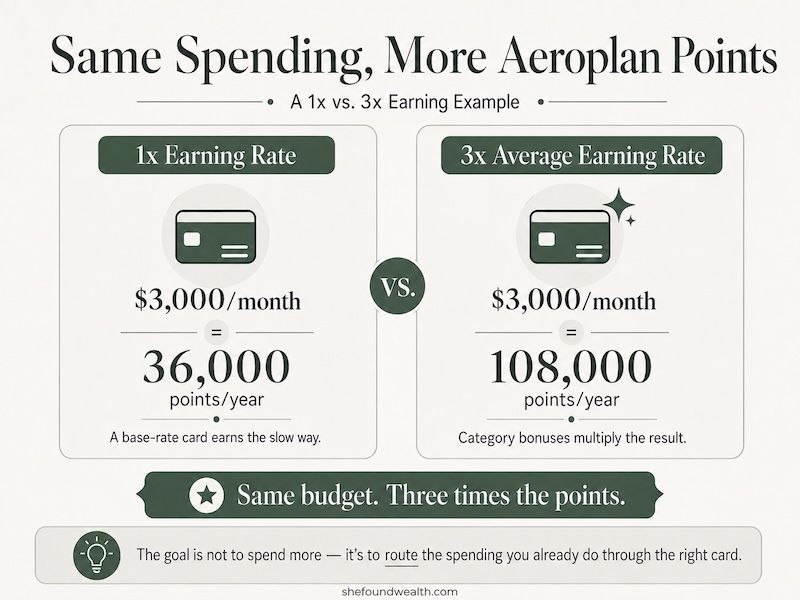
The fundamental principle is simple: you want to minimize the number of dollars you spend earning one point per dollar and maximize the number of dollars you spend earning two, three, or five points per dollar.
The difference compounds significantly over time.
Someone spending $3,000 a month at 1x earns 36,000 points in a year.
The same person spending that same $3,000 at an average of 3x earns 108,000 points.
This is the same budget but 3x the points.
That kind of difference can be the gap between barely covering an economy redemption and having enough points to seriously consider a higher-value booking, like premium economy or business class, depending on your route.
This is why the card you choose matters more than how much you spend.
One client I worked with was putting groceries, restaurants, and food delivery on a basic 1x card because it was the card they had always used. They did not need to spend more to earn more. They just needed their existing spending to go through a card that rewarded the categories they actually used.
Your earning strategy should match your real life, not some idealized version of your spending.
The cards I recommend most often for Aeroplan earning are built around this principle.
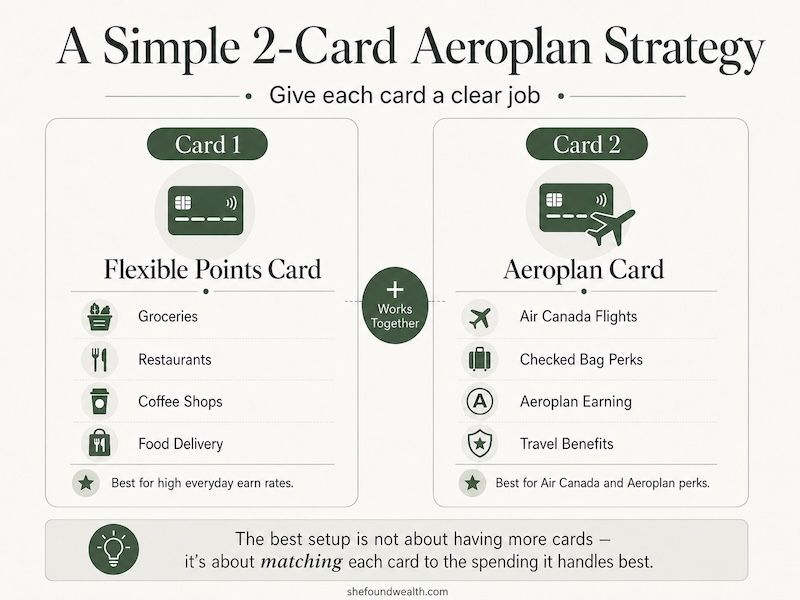
The Amex Cobalt earns strong rewards on food and dining categories, including restaurants, grocery stores, coffee shops, and food delivery. For most Canadians, that category alone represents a significant portion of monthly spending.
The TD Aeroplan Visa Infinite earns directly into Aeroplan and is especially useful for Air Canada purchases and Aeroplan-specific perks, including free checked baggage when you fly Air Canada.
Together, these two cards cover different jobs.
The Amex Cobalt usually does the heavy lifting for everyday food-related spending, especially groceries, restaurants, coffee, and food delivery.
The TD Aeroplan Visa Infinite supports the Air Canada and Aeroplan side of the strategy. It also gives you a Visa option for places that do not accept American Express, which matters because Amex acceptance still is not universal.
I do not use the TD card as often for everyday spending, but it is useful for Air Canada-specific perks, Aeroplan earning, and the occasional promotion where having an Aeroplan card unlocks extra value.
That is the two-card strategy in practice.
I break down both of these cards, along with the other travel cards I actually think are worth considering, in
The Best Travel Credit Cards in Canada I Actually Use.
One thing worth knowing about Amex Membership Rewards points earned on the Cobalt: they are a transferable currency.
That means you can move them into Aeroplan when you are ready to redeem.
You are not earning Aeroplan points directly on the Cobalt, but you are building a balance in a program that partners with Aeroplan, which gives you flexibility on when and how you consolidate.
Since the Cobalt earns transferable points rather than Aeroplan points directly, it helps to understand how flexible rewards programs work. I break that down in
How Do Travel Rewards Points Work in Canada.
The broader principle behind card selection for Aeroplan earning is this: your card portfolio should reflect how you actually spend money.
A card with a high earn rate on dining does nothing for you if you rarely eat out.
A card with a strong travel multiplier does nothing for you if you put all your travel on a different card out of habit.
Before you decide which card to use for which purchase, look at your last two to three months of spending and understand where your money is actually going.
That answer should drive your card strategy, not the other way around.
Credit card offers, earn rates, welcome bonuses, and Aeroplan partner promotions change frequently, so always confirm the current terms before applying or making a purchase.
Welcome Bonuses Are the Fastest Way to Earn Aeroplan Points Quickly
If your credit card earn rate is the engine that builds your points balance over time, the welcome bonus is the turbo boost that gets you there faster.
A welcome bonus is a lump sum of points offered by a credit card issuer when you open a new card and meet a minimum spend requirement within a specified timeframe.
For many people, the welcome bonus alone covers most or all of what they need for their first meaningful redemption before they have even had the card for a year.
That’s why it’s worth understanding
how Canadian credit card sign up bonuses work before choosing your next card.
The math on why welcome bonuses matter is straightforward.
If your card earns 1,000 points per month through everyday spending, it takes you 60 months, or five years, to accumulate 60,000 points organically.
A welcome bonus of 60,000 points earned in the first few months collapses that timeline entirely.
You are not waiting five years for your first big redemption. You may be able to book it before the end of your first year.
This is why I always tell people to pay attention to welcome bonuses when choosing a card.
Not as the only factor, but as a meaningful one.
A card with a strong welcome bonus and strong ongoing earn rates is the combination you are looking for.
The bonus gets you to your first redemption quickly. The earn rates keep your balance building after that.
This is also where the
First Class Calculator helps. Once you know your target points number, you can see whether a welcome bonus gets you halfway there, all the way there, or whether you still need a second earning method to close the gap.
A few things are worth knowing about how welcome bonuses work with Aeroplan specifically.
The terms around bonus eligibility have changed over time and will likely continue to evolve.
When I was building my strategy earlier in my points journey, I was able to cycle strategically between cards to capture multiple welcome bonuses by timing the eligibility windows carefully.
Aeroplan and its card partners have since tightened those terms.
Most programs now have language that prevents you from earning a welcome bonus on a card you have previously held within a certain timeframe. Depending on the issuer, that could be 12 months, 24 months, or sometimes longer.
Always read the current terms before applying.
This is also a reason why getting into the points game sooner rather than later matters.
The landscape changes.
Programs that were generous with bonus eligibility a few years ago are more restrictive now. The people who benefited most from the old terms were the ones who were already in the game when those terms existed.
Every year you wait is a year of potential earning you cannot get back.
It is not a strategy on its own unless you are extremely organized, already comfortable with points earning, and committed to tracking the details carefully.
I only teach welcome-bonus-heavy strategies to clients who have the foundation dialed in first, because missed deadlines, annual fees, and unnecessary spending can quickly wipe out the value of the points.
For most people, the better starting point is choosing one or two cards you plan to keep long term because their everyday earning rates, benefits, and annual fees make sense for how you actually spend.
Use the welcome bonuses to accelerate your balance, then let the ongoing earning do the rest.
Advanced: Should You Open Cards Just for Welcome Bonuses?
Not all credit cards in the points world are held for the same reason.
Understanding the distinction will save you a lot of confusion when you start seeing advice online about opening and closing cards to maximize bonuses.
There are two types of cards in a points strategy: keeper cards and earn-and-burn cards.
Keeper cards are the ones that stay in your wallet long term because they consistently deliver value month after month.
The Amex Cobalt tends to be a keeper card.
The TD Aeroplan Visa Infinite can also be a keeper card.
You hold them because their ongoing earn rates, perks, and annual fee return justify keeping them year after year, not just because of the welcome bonus.
Earn-and-burn cards work differently.
You open them primarily to capture a strong welcome bonus, meet the minimum spend requirement, collect the points, and then close or downgrade the card before the next annual fee hits.
The points are the destination. The card is the vehicle to get there.
Earn and burn is a real strategy, and it can accelerate your points balance meaningfully when executed well.
I have used versions of it myself at different points in my journey.
But I want to be direct about who it is actually for.
It is an advanced strategy.
It requires you to track multiple cards at the same time, monitor minimum spend deadlines, understand the specific terms and conditions around bonus eligibility for each program, and stay on top of annual fee dates.
If you miss a step, you can end up paying an annual fee you did not intend to pay.
Or worse, you can end up spending money you would not otherwise have spent just to hit a minimum spend threshold.
That defeats the whole purpose.
It also carries a risk that most people underestimate.
Chasing welcome bonuses only works if your finances are locked in.
If you are not paying your balance in full every month, the interest charges on a card you opened for a bonus will cost you more than the bonus is worth.
It can spiral quickly.
For the majority of people, especially those who are not traveling at a very high frequency and do not need to accumulate enormous points balances every year, earn and burn is not necessary.
The two-card keeper strategy will build your Aeroplan balance steadily and predictably without the complexity and risk that comes with constantly opening and closing cards.
Start with your keeper cards.
Get comfortable with the system.
Let the welcome bonuses on those cards give you a strong head start.
Then, if you want to explore earn and burn down the line once you have the foundation dialed in, you will be in a much better position to do it without it working against you.
Earn Aeroplan Points Through the Aeroplan eStore
Most Aeroplan members know about credit card earning.
Far fewer take advantage of the
Aeroplan eStore, which is a missed opportunity that costs nothing to fix.
The Aeroplan eStore is a shopping portal that lets you earn bonus Aeroplan points on purchases at participating retailers simply by clicking through to the retailer’s website from the portal before you shop.
You are buying the same products from the same stores you would have used anyway.
The only difference is that you enter through the eStore link first and earn points on top of whatever your credit card is already giving you.
Before buying tech, I always check the eStore rate first because a laptop purchase is one of the easiest ways to accidentally leave thousands of points behind.
The base earn rates are available to everyone.
Bonus earn rates, which are often higher, may be available to members who hold an Aeroplan co-branded credit card or have Aeroplan status.
This is one of the less talked about benefits of holding an Aeroplan card.
For example, if a cardholder bonus rate gives you more points per dollar at a retailer like Apple, the difference matters when you are making a $2,000 laptop purchase.
At 3x, a $2,000 purchase earns 6,000 points.
At 10x, that same purchase earns 20,000 points.
That is a 14,000-point difference without buying anything extra.
Rates change regularly, so the specific numbers will shift. But the strategy stays the same.
The strategy is not to browse the eStore looking for things to buy.
That is how you end up spending money on things you did not actually need in pursuit of points, which is the opposite of what this is about.
The strategy is to know which stores you already shop at, check whether they are on the eStore before you make a purchase, and route your spending through the portal when they are.
The timing piece is where the real leverage is.
The eStore runs bonus events throughout the year where earn rates increase significantly for limited periods.
Black Friday is typically the most dramatic example, but you will also see elevated offers at other times of year.
What this means practically is that if you are planning a bigger purchase, like a new laptop, a season’s worth of clothing, or a large household order, it is worth checking the eStore first.
If possible, time that purchase to coincide with a bonus event rather than buying at the base rate.
I will wait for Apple to run an elevated eStore promotion before buying tech rather than purchasing at the standard rate.
The points difference on a large purchase can be meaningful enough to move you closer to a flight.
A note on Amazon: the eStore may list Amazon, but the earn is usually category-specific and the fine print matters.
Always check what qualifies before assuming your full cart will earn at the advertised rate.
The rule I apply to all of it is simple: I only spend money on things I was already going to buy.
The only exception is when I can stock up on a true necessity in bulk to earn a significant bonus — but only if it is something I know I will use, the price is still fair, and it does not push me outside my budget.
The points are a bonus on top of a decision I would have made anyway.
The moment points start driving purchasing decisions on things you do not actually need, the economics flip and the program is working against you instead of for you.
Earn Aeroplan Points With Everyday Partners
Beyond your credit cards and the eStore, Aeroplan has a network of everyday
retail partners where you can earn points on spending you are likely already doing.
The key word is likely.
This section is about finding the overlap between where you already spend money and where Aeroplan has a partnership.
It is not about changing your life to chase points.
The easiest wins here come from linking your existing accounts.
Starbucks is one straightforward example.
If you are already a Starbucks customer, linking your Aeroplan account to your Starbucks account can unlock bonus earning opportunities that require nothing beyond the initial setup.
I do not go to Starbucks more often for points.
But if I am already buying coffee, I want the account linked so I am not missing passive earning.
Journey, which is a gas and fuel app available in Canada, is another one worth knowing about.
Linking your Aeroplan account to Journey can unlock bonus points on fuel purchases depending on where you are filling up.
Journey also runs periodic bonus promotions where you can select rewards from a menu of options.
I consistently choose the points option over discounts like cents off per litre because when I run the math, the points often deliver more value than the fuel saving.
Gas station partnerships more broadly are worth paying attention to.
If you have flexibility in where you fill up and one option earns Aeroplan points while another does not, the choice is straightforward.
It costs you nothing extra to earn while you drive.
Dining partners are another category where the overlap between existing habits and Aeroplan earning can be meaningful.
Aeroplan has a dining program that lets you earn points at participating restaurants simply by paying with a linked card.
Check which restaurants in your area participate and register your card.
The earning happens automatically after that.
The pattern across all of these is the same as the eStore strategy.
You are not adding complexity to your life or changing your behavior in ways that cost you more money.
You are identifying where your existing spending already overlaps with Aeroplan partnerships and making sure those connections are in place so you earn on every eligible transaction.
The setup is a one-time investment of maybe an hour across all of these platforms.
The earning runs on autopilot after that.
One thing worth noting: Aeroplan’s partner network changes over time.
Partners join and leave the program. Earn rates get updated.
It is worth doing a periodic review, maybe once or twice a year, of which partnerships you have linked and whether any new ones are relevant to how you currently spend.
Five minutes of attention twice a year can make a meaningful difference to your annual points total.
Transfer Points From Other Programs Into Aeroplan
One of the most useful ways to earn Aeroplan points is not always earning Aeroplan points directly.
Sometimes, it is earning flexible points that can become Aeroplan points later.
This is why transferable points matter.
Certain rewards programs partner with Aeroplan and allow you to move points into your Aeroplan account when you are ready to book.
American Express Membership Rewards is one of the most commonly used examples in Canada.
If you hold a card like the Amex Cobalt or Amex Gold and are earning Membership Rewards points, you can transfer those points into Aeroplan when the time is right.
This is one of the reasons the Amex Cobalt works so well as part of an Aeroplan-focused earning strategy even though it does not earn Aeroplan points directly.
You are building a flexible balance first.
Then, once you know the redemption you want, you can move the points where they need to go.
That flexibility is valuable because it gives you options.
If you are still learning how travel rewards work in Canada, start with this
guide before deciding which points you want to earn long term.
When Buying Aeroplan Points Makes Sense
Buying points is the one earning method that most points content either ignores entirely or treats as an always-bad idea.
The reality is more nuanced than that.
Knowing when it makes sense can be the difference between booking a redemption this year and waiting another twelve months to earn organically.
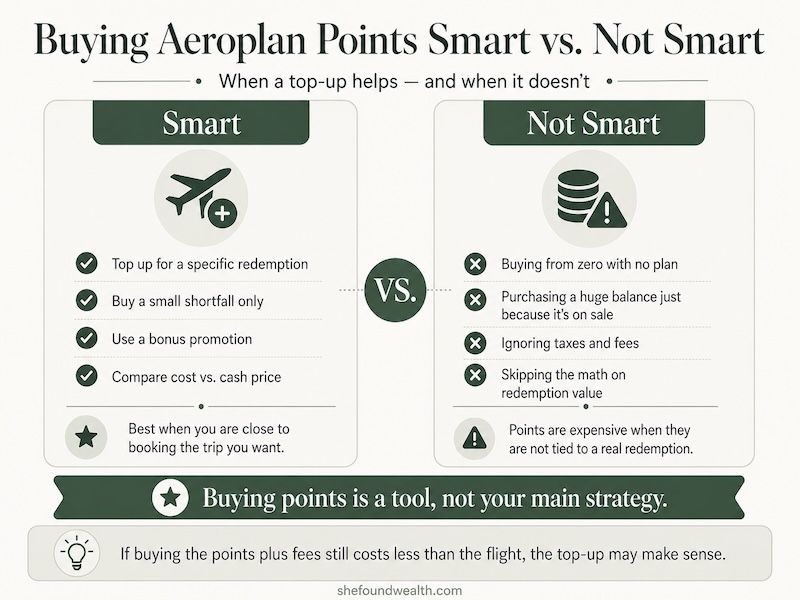
The short version: buying Aeroplan points at the base rate almost never makes financial sense.
Buying during a significant bonus promotion can make sense in the right circumstances.
Here is how to think about it.
Aeroplan periodically runs promotions where they offer bonus points on purchased points.
These bonuses can vary by promotion.
The highest bonus I have personally bought at was 85 percent, and I did it because I needed to top up my balance for a specific trip and the math worked clearly in my favor.
Before buying points at any promotion level, I run three numbers.
First, what is the total cost of the points I need to buy at the current promotion rate?
Second, what is the total cost of the redemption including those purchased points plus the taxes and fees on the flight?
Third, what is the cash price of the same flight?
If the total cost of buying the points plus the fees is a meaningful discount against the cash price, buying makes sense.
If it is not, I wait.
The scenario where buying points works best is when you are close to a redemption but short on points.
For example, maybe you have 50,000 Aeroplan points and you need 60,000 for the flight you want.
A strong bonus promotion might make it reasonable to buy the shortfall so you can book the trip now instead of waiting months to earn those final points organically.
The scenario where buying points does not work is when you are starting from zero and trying to buy your way to a large redemption.
Buying 60,000 points from scratch, even during a generous promotion, can be expensive enough that the discount against the cash price disappears.
The program is not designed to be gamed by purchasing in bulk from nothing.
It works best when you earn organically and occasionally top up for a specific redemption.
A few additional things are worth knowing about buying points.
Aeroplan may offer tiered bonuses on purchased points, meaning the larger your purchase, the higher the bonus percentage you unlock.
If you are going to buy, it can be worth consolidating into a single purchase to access the higher tier rather than making multiple smaller purchases at lower bonus levels.
Taxes may apply to purchased points in Canada, so factor that into your calculation.
The advertised bonus rate is on the points themselves, not necessarily the final cost you will see at checkout.
I have a workshop that goes deeper on the mechanics of
buying points strategically, including how to calculate whether a specific purchase makes sense for your situation and how to access points quickly if your credit is not yet where you want it to be.
The bottom line on buying points: it is a tool, not a strategy.
Used in the right moment for the right redemption, it can accelerate your timeline meaningfully.
Used carelessly, it is an expensive way to accumulate points you are overpaying for.
Know the math before you commit.
Common Questions About Earning Aeroplan Points
How Many Aeroplan Points Can You Earn Per Month?
It depends entirely on your spending habits, which cards you hold, and how actively you use the eStore and partner network.
Someone spending $3,000 per month with a single card earning at base rate earns roughly 3,000 points per month.
Someone spending the same $3,000 across a strategic two-card setup with category multipliers could earn 6,000 to 9,000 points or more on the same spending.
Layer in a welcome bonus, a well-timed eStore purchase, and a few partner earning moments, and the monthly total can look very different.
The ceiling is much higher than most people realize when the full system is working together.
Can You Transfer Points From Other Programs Into Aeroplan?
Yes, certain transferable points programs partner with Aeroplan and allow you to move points in.
American Express Membership Rewards is one of the most commonly used.
If you hold the Amex Cobalt or Amex Gold and are earning Membership Rewards points, you can transfer those into your Aeroplan account when you are ready to book.
This is one of the reasons the Amex Cobalt works so well as part of an Aeroplan-focused earning strategy even though it does not earn Aeroplan points directly.
You are building a transferable balance that can become Aeroplan points when the time is right.
How Long Does It Take to Earn Enough Points for a Flight?
With a strong welcome bonus and a strategic two-card setup, many people can reach a meaningful Aeroplan redemption within their first year.
A welcome bonus alone on a premium travel card can deliver a major head start after meeting the minimum spend.
Add ongoing earn from daily spending and a few eStore purchases, and the timeline compresses further.
The honest answer is that it depends on your spending volume and your redemption target.
That is exactly why the
First Class Calculator exists.
Use it to work backward from your specific dream trip and understand exactly what you are building toward before you start.
Does Aeroplan Have a Referral Program?
Aeroplan has had referral bonuses through its credit card partners at various points, where both the existing cardholder and the new applicant receive bonus points when someone is referred and approved.
The availability and terms of referral offers change frequently and vary by card issuer.
Check the current offer on the specific card you are interested in at the time you are applying.
If a referral bonus is available, it is worth using since it adds points to your balance for an action you were going to take anyway.
Do Your Points Earn Faster With Aeroplan Status?
Yes, Aeroplan elite status can help you earn points faster when you fly.
Status is earned by flying a certain number of segments or accumulating qualifying activity with Air Canada and eligible partners in a calendar year.
Aeroplan status can come with bonus points on eligible flying activity, and higher tiers may receive larger bonuses.
Status may also unlock better earn rates on certain eStore partners.
If you are flying Air Canada regularly anyway, the points acceleration from status on top of your card earning can be meaningful.
If you are not flying frequently enough to earn status organically, it is not worth chasing status specifically for the earning bonus.
What Is the Fastest Way to Earn Aeroplan Points?
The fastest way to earn Aeroplan points is usually through a strong welcome bonus combined with a card that matches your everyday spending.
After that, the easiest accelerators are the Aeroplan eStore, transferable points, and linked partner accounts.
Buying points can be fast, but it should only be used when the math works for a specific redemption.
The fastest strategy is not spending more.
It is making the spending you already do earn more efficiently.
Set Up the System Before You Spend More
Earning Aeroplan points efficiently is not about spending more.
It is about making sure the spending you are already doing is pointed in the right direction.
The credit cards do the heaviest lifting.
Choose keeper cards with strong multipliers in the categories that match your actual spending, use the welcome bonuses as a head start, and let the two-card strategy earn for you on autopilot.
Layer in the eStore for purchases you were already going to make.
Link your accounts with everyday partners.
Time your bigger purchases around bonus events.
And when you are close to a redemption and a strong bonus promotion appears, run the numbers on buying the shortfall.
None of this requires you to spend differently.
It requires you to set up the system once and then let it work.
Before you open another card or chase another bonus, use the
First Class Calculator to figure out your actual points target.
That way, you are not just earning points randomly.
You are building toward a specific trip.
Ready to put those points to work? Learn
how to redeem Aeroplan points for maximum value.
And if you are still building your foundation on how travel rewards work in Canada, start here:
How Do Travel Rewards Points Work in Canada.
Not sure how many Aeroplan points you need? Calculate your dream trip before choosing your earning strategy.
Download First Class Calculator