RBC Avion points are one of the most flexible travel rewards currencies in Canada.
They’re also one of the easiest to waste.
Most Canadians redeem Avion points the simplest way possible: directly through the RBC Avion travel portal. It works, it’s straightforward, and at first glance it even looks like decent value — especially when RBC advertises boosted redemption rates for business and first class flights.
But after comparing Avion portal pricing against airline transfer partner redemptions, I realized something:
The “easy” option is usually the most expensive option once premium cabins enter the picture.
For example, I found a Toronto to London British Airways business class flight pricing at over 260,000 Avion points roundtrip through the RBC portal.
Meanwhile, I booked a Montreal to Bangkok itinerary using transferred Avion points that included:
- Qatar Airways Qsuites
- an international first class segment on the Qatar A380
- a stopover in Doha
The total cost was 190,000 Avios roundtrip — or 95,000 points one way.
And because I transferred during a 30% RBC transfer bonus to British Airways Avios, the redemption effectively only cost around 146,000 RBC Avion points total for a trip that was more than double the distance.
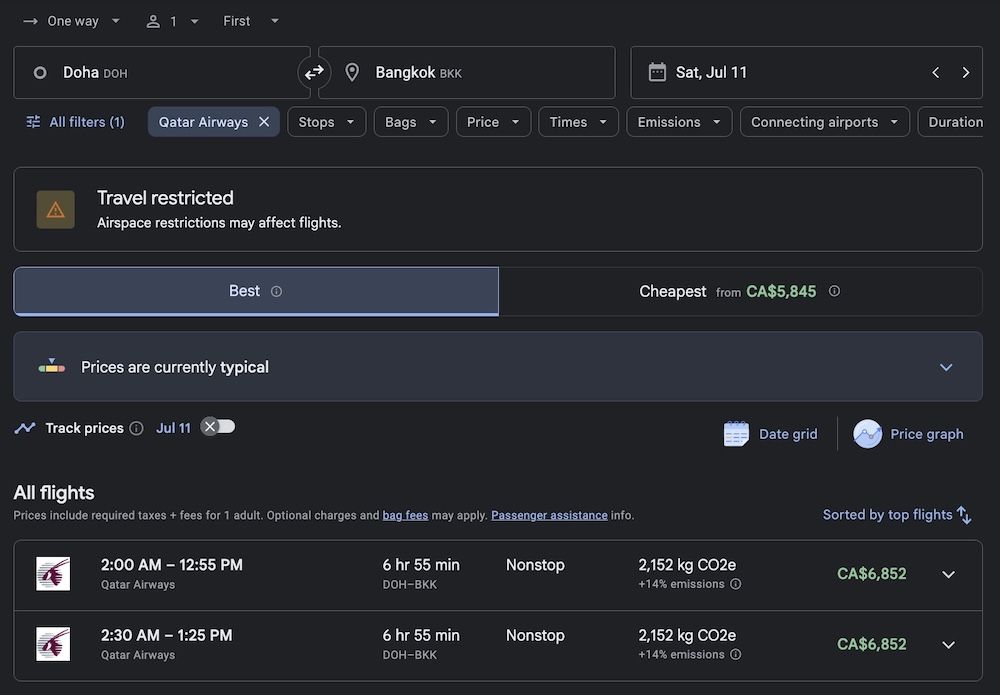
The Doha to Bangkok first class segment alone regularly sells for around $7,000 CAD one way.
That was the moment I realized Avion points are only as valuable as the redemption method you choose.
This guide breaks down:
- how Avion points for flights actually work
- when the RBC portal makes sense
- when transferring to airline partners gives dramatically better value
- how many Avion points you realistically need for business and first class travel
- the biggest Avion mistakes Canadians make
If you’ve been collecting Avion points but have no idea whether to redeem them directly or transfer them, this is the strategy guide I wish I had when I started.
How Do Avion Points Work?
Unlike cashback-style rewards programs, RBC Avion is a transferable points currency.
That distinction matters because transferable points can unlock wildly different value depending on how you redeem them.
Most people assume points work like this:
- 1 point = fixed dollar value
- redeem points
- flight gets cheaper
That’s basically how the RBC portal works.
But airline transfer partners often operate differently.
When you transfer Avion points to a partner like British Airways Avios or Cathay Pacific Asia Miles, you stop redeeming based on the cash price of the ticket and start redeeming based on the airline’s award pricing system.
That’s how the same number of points can either:
- cover a modest economy flight through the portal
or - book a lie-flat business class seat worth thousands of dollars
This is what makes Avion such a powerful program for Canadians who want to travel in premium cabins. If you’re still deciding which RBC card makes the most sense for your travel goals, read the
best RBC cards for Canadians.
The Two Ways to Redeem Avion Points for Flights
There are really only two ways to use RBC Avion points for flights.
Book Through the RBC Avion Travel Portal
This is the simplest option.
You search flights through the Avion portal like you would on Expedia or Google Flights, then apply points toward the booking.
The portal essentially treats your points like a fixed-value currency.
For most flight bookings:
- 100 points ≈ $1 CAD toward travel
RBC also offers improved redemption rates for business and first class bookings, which sounds attractive on paper.
- 200 points ≈ $2 CAD toward travel
But this is where many Canadians accidentally burn huge amounts of value.
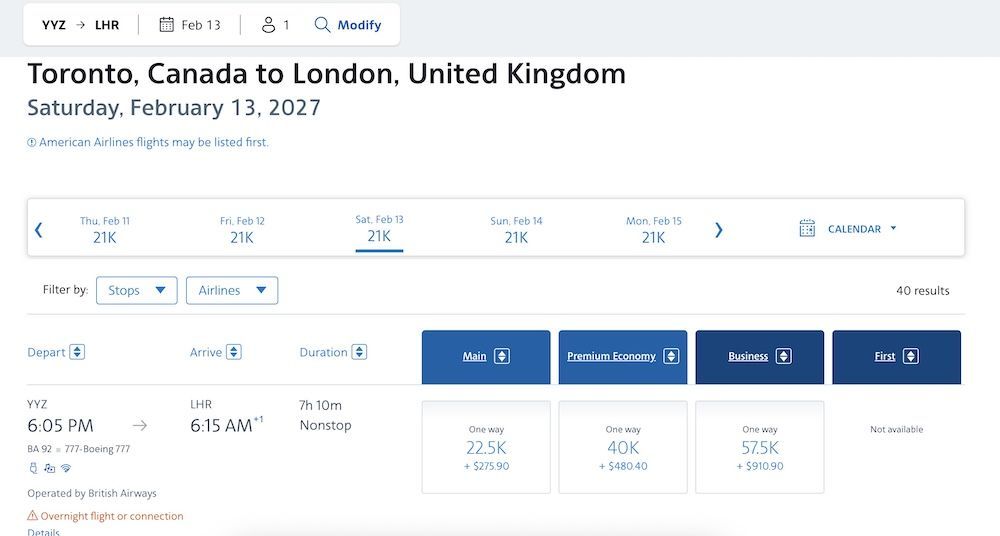
I compared a Toronto to London British Airways business class itinerary for February 13 through both the Avion portal and airline transfer partners.
The result was shocking.
The RBC portal priced the roundtrip business class flight at approximately:
- 261,000 Avion points
- or over $5,200 CAD
Meanwhile, booking through transfer partners like American Airlines AAdvantage required dramatically fewer points for the exact same business class route.
The outbound Toronto to London flight priced at just:
- 57,500 American Airlines AAdvantage miles one way
- plus approximately $910 CAD in taxes and fees
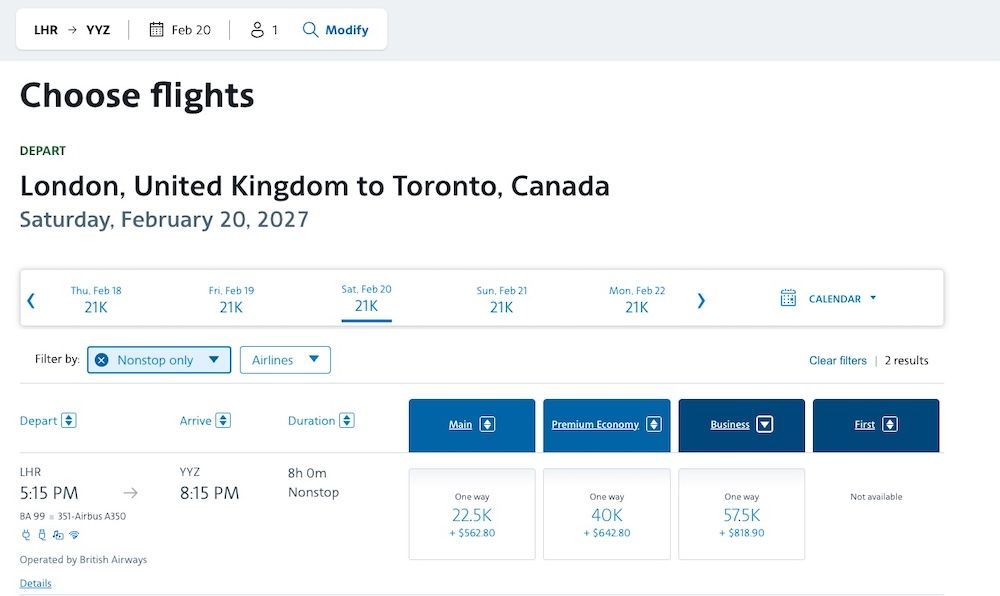
The return flight from London back to Toronto priced at the exact same 57,500-mile level through American Airlines, bringing the total roundtrip cost to:
- 115,000 AAdvantage miles
- plus taxes and fees
Even after accounting for RBC’s weaker 1:0.7 transfer ratio to American Airlines, the transfer partner route still required dramatically fewer points than redeeming directly through the Avion portal.
At standard transfer rates, the same roundtrip business class itinerary would require roughly:
During RBC’s occasional 15% transfer bonus promotions to American Airlines — which typically appear around August — that number drops closer to:
Compared to the 261,000+ points required through the portal, the value difference becomes difficult to ignore.
To be fair, I’m not ignoring the taxes and fees.
British Airways redemptions to London can come with very high surcharges, and you may still be paying four figures out of pocket.
England is infamous for high airport taxes and fees, especially in premium cabins.
But even with those fees, I would rather pay the surcharge than burn through 261,000 Avion points on a portal booking — especially when a transfer partner redemption could require nearly 120,000 fewer points for the exact same route.
And even with four-figure taxes and fees, the total out-of-pocket cost would still be far cheaper than paying the full cash fare for business class.
At first glance, the portal feels reasonable because RBC markets premium cabin redemptions as offering better value.
But once you understand transfer partners, the gap becomes hard to ignore.
Transfer to an Airline Partner Program
This is where Avion becomes undeniably valuable.
RBC Avion transfer partners currently include:
- British Airways Executive Club (Avios)
- American Airlines AAdvantage
- Cathay Pacific Asia Miles
- WestJet Rewards
When you transfer points, you exchange Avion points into airline miles.
That means:
- 10,000 Avion points becomes 10,000 Avios
- or more during transfer bonus promotions
This completely changes how your points function.
Instead of covering a cash price, you access airline award pricing — and that’s where premium cabin sweet spots live.
Why Transfer Partners Usually Give Better Value
The best value from Avion points almost always comes from international premium cabin redemptions through airline partners.
My Qatar Airways booking is the perfect example.
I transferred Avion points to British Airways Avios during a 30% transfer bonus promotion and booked:
- Montreal → Doha in Qatar Qsuites
- Doha → Bangkok in Qatar Airways international first class
The total cost was:
The Doha to Bangkok first class segment alone regularly sells for around $7,000 CAD one way based on Google Flights pricing.
Meanwhile:
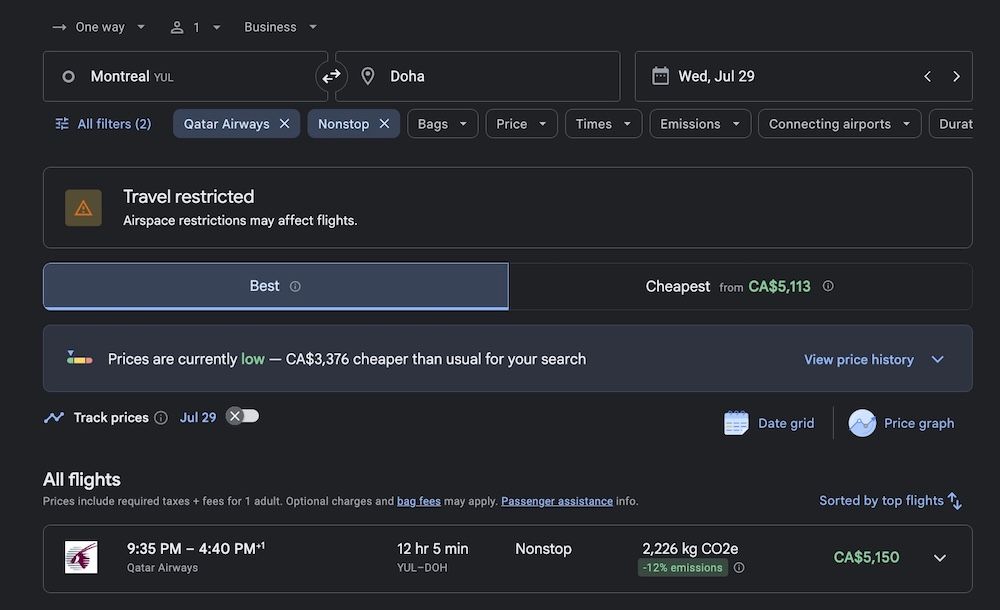
- Montreal → Doha business class alone often prices around $5,000+ CAD one way
- and that was actually considered low pricing compared to typical dates
If I had tried to book equivalent premium travel through the Avion portal, the points cost would have been dramatically higher because portal pricing is still tied to cash prices.
That’s the key difference:
- portal pricing follows cash prices
- transfer partners follow award charts
Once I understood that, I stopped viewing Avion as a “travel cashback” program and started treating it like a premium airline currency.
What Are RBC Avion Points Worth?
The honest answer is:
it depends entirely on how you redeem them.
Approximate Avion Point Values
Through the RBC Portal
- ~1 cent per point for economy flights
- ~ 2 cents per point for business and first class cabin portal bookings, but still fixed-value based
Through Transfer Partners
- British Airways Avios: often 3–10+ cents per point on premium redemptions
- American Airlines AAdvantage: often 1.5–5 cents per point
- Cathay Pacific Asia Miles: strong value to Asia and premium long-haul routes
The difference can be enormous.
That’s why two people can both redeem 100,000 Avion points and receive completely different value.
One person might book:
- a modest economy redemption
Another person might book:
- a lie-flat business class seat worth several thousand dollars
You can have the exact same number of points and get a drastically different travel experience just by understanding how the system works and using the right strategy.
The Biggest RBC Avion Mistakes Canadians Make
Redeeming Points for Merchandise
Please do not redeem your Avion points for sunglasses, electronics, gift cards, or random catalog items.
This is usually the worst possible redemption value.
Using the Portal for Premium Cabins
The portal is not inherently bad.
It can actually make sense for:
- domestic economy flights
- cheap short-haul routes
- situations with no award availability
But premium cabins are where transfer partners usually outperform the portal by a huge margin.
Transferring Before Checking Availability
This is one of the biggest beginner mistakes.
Transfers from RBC Avion are one-way only.
Always:
- find the award seat first
- confirm availability
- THEN transfer points
Never transfer speculatively unless you are very confident in your strategy.
For beginners, I usually recommend finding the award seat first, confirming availability, and then transferring the points.
That said, I do sometimes transfer points before I have a specific trip booked. For example, I knew I wanted to fly Qatar Airways, so I transferred Avion points to Avios before choosing my exact route.
I was intentionally preparing my points portfolio so that when the right Qatar redemption appeared, I could move quickly.
This is an advanced strategy I use for myself and some clients who are flexible, want to experience different premium carriers, and are building toward future travel.
But it does not make sense for everyone.
If you always travel to the same destination, only want one specific airline, or do not have a clear points strategy, spreading points across different programs can create more problems than value.
Your transfer strategy should always be based on your travel goals, spending habits, flexibility, and the airlines you realistically want to fly.
Ignoring Transfer Bonuses
RBC periodically offers transfer bonuses to programs like British Airways Avios.
I booked my Qatar redemption during a 30% transfer bonus, which massively increased the value I received.
These bonuses can completely change what your points are capable of booking.
If you want to understand how transfer bonuses work strategically, read
the full guide to transferring RBC Avion points to British Airways Avios.
How Many Avion Points Do You Need to Fly?
The answer depends entirely on:
- your destination
- cabin class
- transfer partner
- transfer bonus timing
- award availability
- and whether you redeem through RBC’s portal or airline partners
But understanding the rough ranges helps explain why redemption strategy matters so much.
Through the RBC Avion Portal
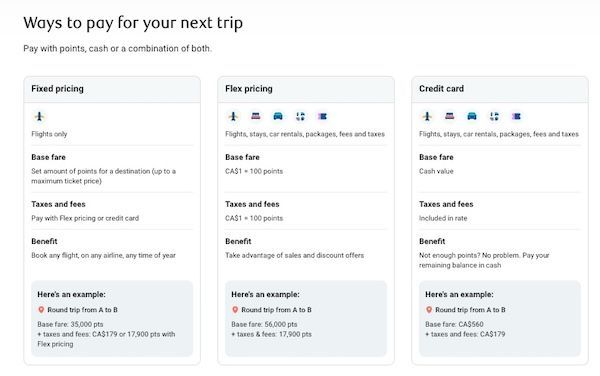
RBC Avion has two different flight redemption systems:
- Fixed Points Pricing
- Flexible Pricing
Most beginners don’t realize these work very differently.
Fixed Points Pricing
Fixed pricing is RBC’s traditional redemption chart.
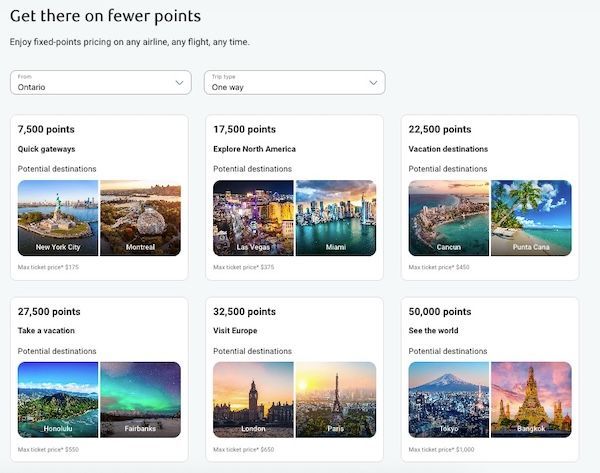
Instead of pricing flights based directly on cash value, RBC sets predetermined point amounts depending on:
- region
- trip type
- maximum ticket price threshold
For example, RBC may allow:
- a North America flight for 17,500 points
- or a Europe flight for 32,500 points
…but only if the cash fare stays under RBC’s maximum allowed ticket price.
Once the ticket price exceeds that threshold, you either:
- pay the difference in cash OR
- switch to flexible pricing
This system can occasionally provide decent value for economy travel, especially on expensive cash fares that still fall under the pricing cap.
Flexible Pricing
Flexible pricing works more like a traditional travel portal.
Instead of award charts or redemption bands:
- your points simply offset the cash cost of the ticket
Typically:
- 100 Avion points ≈ $1 CAD
This gives you:
- more flexibility
- no ticket price caps
- access to almost any flight
But it also means premium cabin flights can become extremely expensive in points.
For example:
- business class international flights can easily exceed 200,000+ Avion points through the portal
That’s why many advanced users prefer transfer partners for premium travel.
Through Transfer Partners
Transfer partners are where Avion points can become dramatically more valuable.
Some rough examples:
- North America → Europe economy: from ~13,000 Avios
- North America → Doha in Qatar Qsuites: ~70,000 Avios
- Premium Asia itinerary with a first class segment: ~95,000 points one way
The difference is massive because transfer partners use airline award pricing instead of fixed-value portal pricing.
That’s also why two people with the exact same Avion points balance can end up with completely different travel experiences.
One person might redeem for:
- a modest economy flight through the portal
Another might redeem for:
- a lie-flat business class seat worth several thousand dollars
You can have the exact same number of points and get a drastically different travel experience just by understanding how the system works and using the right strategy.
If you want help estimating how many points your own dream trip could realistically require, use the
First Class Calculator before transferring or redeeming your Avion points.
Is Booking Flights With Avion Points Difficult?
Honestly:
it’s more complicated than using the portal.
But not nearly as complicated as people assume.
The biggest learning curve is understanding:
- airline alliances
- award availability
- transfer partners
- flexible dates
Once you understand those concepts, the value difference becomes difficult to ignore.
That said, premium award travel is not unlimited.
The best redemptions:
- require flexibility
- change constantly
- can disappear quickly
- are often easier to find months in advance
This is not “click a button and instantly fly first class forever.”
But the outsized value is absolutely real.
When Should You Use the RBC Avion Portal Instead?
Despite everything above, the portal absolutely still has uses.
The RBC Avion portal makes sense when:
- you want simplicity
- economy fares are cheap
- there’s no partner award availability
- you’re booking short-haul domestic travel
- cash prices are unusually low
Sometimes convenience genuinely wins.
The mistake is assuming the portal is always the best value simply because it’s the easiest redemption option.
Should You Transfer Avion Points to British Airways Avios?
For many Canadians interested in premium travel:
yes.
British Airways Avios is one of the most useful RBC Avion transfer partners because it gives access to:
- Qatar Airways
- British Airways
- Iberia
- and other alliance carriers
This is where many of the strongest premium cabin sweet spots exist.
Especially:
- Qatar Qsuites
- short-haul partner flights
- premium international business class
If you want a deeper breakdown of Avios transfer ratios, partner airlines, and when to transfer during a bonus, read
the complete RBC Avion to Avios transfer guide.
If you’re comparing Avion against other Canadian travel rewards ecosystems, read the
best travel rewards programs in Canada.
Before You Redeem Your Avion Points
Most Canadians are not maximizing their Avion points.
That’s completely normal.
The portal is designed to feel easy and intuitive, while transfer partners require a bit more strategy.
But once you see the difference in value between:
- fixed-value portal bookings
and - premium airline transfer redemptions
…it becomes hard to go back.
Before redeeming your Avion points through the portal, figure out what those same points could potentially unlock through transfer partners.
That’s exactly why I built the
First Class Calculator.
You can use it to:
- estimate how many points your dream trip actually requires
- compare approximate cash values
- understand whether your current points balance is enough for business or first class travel
Because the difference between “a couple economy flights” and “Qatar Airways first class” is often not how many points you have.
It’s how you use them.
But once you see the difference in value between fixed-value portal bookings and premium airline transfer redemptions…it becomes hard to go back.”
And if your next question is how to actually earn enough points for these types of redemptions faster, read
the guide to earning premium flight points through your business expenses.