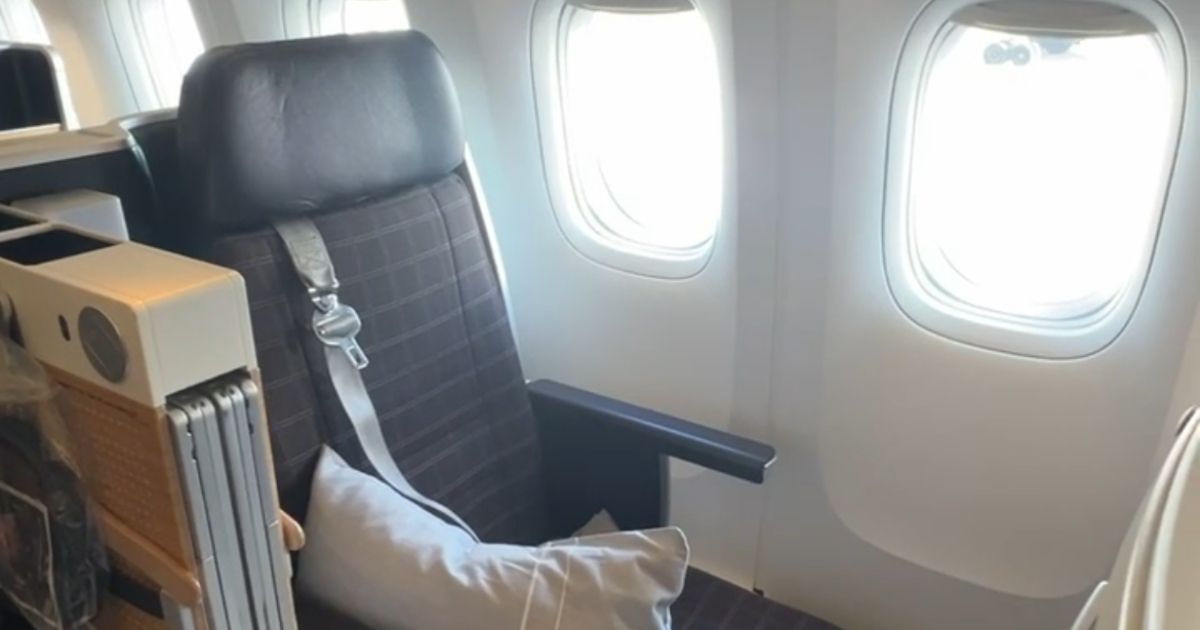
The first time I flew business class, I didn’t even book it with points.
I was flying from Egypt to Dubai after a networking trip with a friend, and I was exhausted. At the airport counter, I found out I could upgrade to Emirates business class for around $200.
I had no idea that was even possible.
I remember walking onto the plane and feeling like I had made a wrong turn. I didn’t know the seat would be that comfortable. I didn’t know I would actually sleep. And I definitely didn’t understand yet how much better flying could feel when I wasn’t crammed into economy.
That flight didn’t teach me how to use points.
But it did teach me something just as important: if I wanted to make travel a bigger part of my life while managing chronic pain, I needed to learn how to make premium travel more accessible.
That flight became the catalyst.
Once I realized business class wasn’t only for people with huge incomes, airline jobs, or luxury travel budgets, I felt relieved. There were systems. There were upgrades. There were points. There were strategies regular people could learn.
Since then, I’ve used points to fly business class with Aeroplan on Air Canada, Swiss Airlines, Lufthansa, and Singapore Airlines. I’ve also taken my grandmother to Germany, Switzerland, and Singapore, covering both of our flights with points.
I’ve even booked an aspirational Qatar Airways first class flight to Bangkok for less than $500. Unfortunately, I didn’t get to take that trip due to conflict in the Middle East, but it still remains one of my favourite redemptions because it showed me what was possible.
None of it cost what most people assume.
If you’re in Canada and flying business class with points sounds confusing, unrealistic, or only possible for people with endless credit cards, I get why it feels that way.
But it is more doable than you think once you understand how the system works.
In this post, I’ll show you how to fly business class with points in Canada, why Aeroplan is usually the best place to start, how to avoid booking the wrong “business class” seat, and how to figure out how many points you actually need before you start collecting blindly.
How to Fly Business Class with Points in Canada: The Quick Answer
To fly business class with points in Canada, you need to:
- Choose the right points program, usually Aeroplan for beginners.
- Figure out how many points your route will cost.
- Earn those points through the right credit card strategy, spending categories, and welcome bonuses.
- Search for business class award space.
- Confirm the aircraft has lie-flat seats before you book.
- Compare the taxes and fees.
- Book the flight before the award space disappears.
That is the simple version.
The complicated part is that every step has traps beginners do not know to look for.
You can have the wrong type of points. You can be short on points and think the taxes are high when Aeroplan is actually charging you to buy extra points. You can book something labeled business class and then realize it is not a lie-flat seat. You can search only from your home airport and miss better availability nearby.
That is why this post is not just about how to book business class with points.
It is about how to fly business class with points in Canada without collecting blindly, wasting points, or booking the wrong seat.
If you are still learning how points work overall, start with
how travel rewards points work in Canada first. If you already collect Aeroplan points but have never used them for business class, you are in the right place.
First, Understand What “Business Class” Actually Means
Before we get into Aeroplan points, award space, and booking strategy, we need to clear up something that confuses almost every beginner.
Business class is not one single thing.
The experience you get depends on:
- The airline
- The route
- The aircraft type
- Whether it is a wide-body or narrow-body plane
- Whether the seat is actually lie-flat
This matters because you can book a ticket that says “business class” or even “first class” and still not get the premium pod experience you are imagining.
I learned this the disappointing way.
Years ago, I booked what I thought was going to be an exciting first class flight to Atlanta on Delta. In my head, “first class” meant I was getting something like Delta One.
I pictured a pod. A lie-flat seat. The whole luxury experience.
Then I boarded a regular narrow-body plane and realized first class just meant wider seats at the front of the plane. Instead of three seats per row, there were two.
Was it better than economy? Yes.
Was it the premium experience I thought I booked? Absolutely not.
That was when I started paying attention to the aircraft type, not just the cabin label.
Wide-Body vs Narrow-Body Planes
If you remember nothing else from this section, remember this:
For your first big business class redemption, you probably want a wide-body international plane with lie-flat seats.
On a wide-body plane, usually flying a long-haul international route, business class often means:
- A lie-flat seat
- More privacy
- Better storage
- Full meal service
- Better bedding
- Noise-cancelling headphones
- A seat that feels more like a pod
- The ability to actually sleep horizontally
This is the type of business class most people are dreaming about when they say they want to fly business class with points.
On a narrow-body plane, usually flying shorter domestic or regional routes, the premium cabin is usually much less exciting.
In North America, that often means a wider recliner-style seat.
In Europe, it may be a row of 3 economy-style seats with the middle seat blocked.
Either way, it is not the same as an international lie-flat pod.
This is why I do not recommend using your first major points redemption on a short narrow-body business class flight unless you have a specific reason, like accessibility needs, a special occasion, or points that are about to expire.
For your first big points booking, aim for long-haul and lie-flat.
That is where business class feels the most different from economy, and where your points can create the kind of travel experience most beginners are actually dreaming about.
Business Class vs First Class
People also assume first class is always better than business class.
That is not always true.
Before I started flying business class, I did not even know there was a distinction between first class and business class, or between long-haul and short-haul premium cabins. I only learned the technical terms “wide-body” and “narrow-body” in the past couple of years.
So if this feels confusing, you are not behind. This is not something the average person would automatically know unless they have flown premium cabins domestically and internationally.
Some people would probably call the flights I fly “first class” because, to them, anything better than economy feels like first class. And honestly, I get it.
But the distinction matters when you are booking with points because the cabin name does not always tell you what the experience will actually be.
Air Canada, for example, does not have a true international first class. Their premium cabin on long-haul routes is called Signature Class, which is business class with lie-flat pods.
Singapore Airlines has both business class and first class. I have flown Singapore Airlines business class, and honestly, the business class experience was already so good that I would not automatically spend significantly more points for first class unless it was a very special redemption.
On one of my Singapore Airlines flights, the first class cabin looked fairly comparable to business class from what I could see. The seat looked more spacious, and there were fewer people in the cabin — around six seats in first class versus more than ten in business class. But personally, I do not need that much extra attention for the points difference to always make sense.
That said, Singapore Airlines also has a famous first class suite you may have seen on social media. That product looks more like a mini apartment in the sky, and that is the kind of first class experience I would consider a points splurge.
The catch for Canadians is that this is not easy to book with Canadian credit card points. Those Singapore Airlines first class suites generally need to be booked through Singapore Airlines KrisFlyer, and Canadian credit cards do not have the same easy transfer access to KrisFlyer that some U.S. credit cards do.
Then there are short-haul “first class” flights on narrow-body planes that are nowhere near as good as long-haul international business class.
So when you are comparing cabins, do not only ask, “Is this business or first?”
Ask:
- Is this a wide-body aircraft?
- Is the seat lie-flat?
- How long is the flight?
- Is this a domestic, regional, or international route?
- Is this product actually worth the points?
- Would I feel a major difference compared to economy?
For this post, when I say business class, I am talking about the kind of redemption most beginners actually want: international lie-flat business class on a wide-body plane.
If you want a deeper breakdown, read
business class vs first class Canada after this.
Why Aeroplan Is Usually the Best Program for Canadians
There are several ways Canadians can fly business class with points, but Aeroplan is usually the best place to start.
Aeroplan is Air Canada’s loyalty program, and it is one of the most useful programs for Canadians because you can use Aeroplan points to book flights on Air Canada
and a long list of partner airlines.
That gives you access to far more than just Air Canada flights.
If you are building a Canadian travel rewards strategy, you should understand
how to use Aeroplan points without wasting them, because Aeroplan can be incredibly powerful when you use it properly.
Aeroplan Gives You Access to Star Alliance Partners
Aeroplan is connected to Star Alliance, which means you can use Aeroplan points to book partner airlines like:
- Air Canada
- Swiss International Air Lines
- Lufthansa
- ANA
- Singapore Airlines
- United Airlines
- Turkish Airlines
- TAP Air Portugal
- EVA Air
- Ethiopian Airlines
- And more
This is one of the reasons Aeroplan is so useful.
You are not limited to Air Canada’s own planes. You can use your points to access some of the best business class products in the world through partner airlines.
That said, not every partner airline is equal.
The airline, route, aircraft, and cabin layout all matter.
This is why I do not just search “business class” and book whatever appears. I look at the airline, the plane, the seat, the fees, and the total experience.
If you want to understand the partner options more deeply, read
Aeroplan partner airlines next.
Aeroplan Has Predictable Award Pricing
Aeroplan uses a distance and
zone-based award chart.
That means the number of points required for a flight is usually somewhat predictable, especially when booking partner awards.
As a general starting point, one-way business class redemptions on the lower end of Aeroplan’s award chart may cost around:
- Canada to Europe: 60,000 to 75,000 Aeroplan points
- Canada to Asia: 85,000 to 95,000 Aeroplan points
- Canada to Africa: around 65,000 Aeroplan points
- Canada to South America: around 50,000 Aeroplan points
- Within North America: around 15,000 to 30,000 Aeroplan points
These are not guaranteed prices. Aeroplan pricing depends on the distance flown, the zones you are travelling between, the airline you book, and whether you are seeing partner award pricing or Air Canada’s dynamic pricing.
But this gives you a general idea of what you are working toward.
And this is exactly why knowing your target matters.
If your dream flight requires 87,500 points and you only have 42,000 points, you do not have a taxes-and-fees problem. You have a points gap.
That was one of the biggest mistakes I made when I first started.
The Beginner Mistake I Made with Aeroplan Taxes and Fees
One of the most confusing things when I first started booking business class with points was getting all the way to the checkout screen and seeing a huge cash amount.
At first, I thought, “Wait, why are the taxes and fees so expensive?”
But the issue was not always the taxes.
Sometimes I simply did not have enough points, so Aeroplan was adding the cost of buying extra points into the checkout price. That made the redemption look way more expensive than it actually was.
I did not understand that at first.
I thought I was looking at taxes and fees, when really I was being charged a premium because I was short on points.
This is why I always tell beginners to know how many points they need before they start searching seriously.
If you are short on points, the checkout screen can be misleading.
That is one of the reasons I built the
First Class Calculator. It helps you figure out how many points you need for your route and cabin before you start guessing, transferring points, or assuming a redemption is out of reach.
If you are still in the earning stage, read
how to earn Aeroplan points faster before you start trying to book.
How to Book Business Class with Aeroplan Points
Once you understand what kind of business class you are looking for, the booking process becomes much easier.
Here is the beginner-friendly version.
Step 1: Figure Out How Many Points You Need
Before you search for flights, you need a rough points target.
This matters because you do not want to collect points blindly.
You want to know:
- Which destination you are working toward
- Which cabin you want
- Whether you need a one-way or round-trip flight
- Whether you are booking for one person or more than one person
- How many points you need before taxes and fees
For example, my best Aeroplan business class redemption so far was flying Singapore Airlines business class with my grandmother.
We flew from
Singapore to
New York with a stopover in
Frankfurt. It cost 87,500 Aeroplan points plus $252.50 in taxes and fees per person.
That was for roughly 19 hours of travel in business class.
That is the kind of number I want you to know before you start building your strategy.
Not “I need a lot of points.”
A specific number.
That is what makes the goal feel possible.
Before you open another travel credit card or transfer points, use the
First Class Calculator to estimate how many points you need for your destination and cabin.
After you download it, plug in your dream route first. If the number feels exciting but overwhelming, that is when it may be worth booking a strategy call so we can map out how to get you there.
Step 2: Search for Business Class Award Space
Award space means the seats an airline makes available to book with points.
This is where a lot of beginners get stuck.
The flight might exist. The seat might be available for cash. But that does not mean it is available to book with points.
To search through Aeroplan:
- Log in to your Aeroplan account.
- Search your route.
- Select “Book with points.”
- Choose business class as your cabin.
- Compare Air Canada and partner airline options.
- Check the points cost and cash fees.
- Confirm the aircraft before booking.
Award availability can appear at different times.
Some airlines release seats far in advance, often around 330 to 355 days before departure. Other seats may open closer to the travel date if the airline has unsold premium cabin space.
This is why planning early helps.
But last-minute availability can also be incredible if you have the flexibility to use it.
Step 3: Be Flexible in More Than One Way
People in points and miles always say “be flexible.”
But I do not think beginners realize how many types of flexibility matter.
It is not just about your travel date.
You can also be flexible with:
- Departure airport
- Arrival airport
- Connection city
- Airline
- Routing
- Trip length
- Positioning flights
- Whether you book one-way or round-trip
I live in
Toronto, but I do not only search from Toronto.
If I am flying all the way to Asia or Europe, I would rather take a short positioning flight to New York and then get seven hours in a lie-flat pod than force myself to only look for a direct flight from Toronto that may not exist on points.
That mindset shift changed everything for me.
Instead of asking, “Why is there no perfect flight from Toronto?” I started asking, “What nearby airport gives me the best premium cabin availability?”
For Canadians, this can be especially important.
Depending on where you live, it may be worth checking
nearby Canadian and U.S. airports.
For example, you might search from:
Do not make your search so narrow that you miss a much better redemption.
Step 4: Confirm the Plane Type Before You Book
This is the step most beginners skip.
Do not book just because Aeroplan says “business class.”
Before you book, confirm the aircraft type and seat layout.
You want to know whether the plane has:
- Lie-flat seats
- Direct aisle access
- A true business class cabin
- An older or newer product
- A wide-body aircraft for long-haul flights
Check the aircraft on Aero Lopa (LINK) and compare it with recent seat maps or flight reviews.
Aircraft swaps can happen, so nothing is guaranteed forever. But checking before you book gives you the best chance of getting the experience you actually want.
This matters because a business class label does not always equal a business class experience.
Step 5: Compare Taxes and Fees
When you book an award flight, you do not only pay points.
You usually pay points plus taxes and fees.
Sometimes those fees are low. Sometimes they are painful.
I do not automatically reject a redemption just because the taxes and fees are higher. I look at what I am getting in return.
For example, I would be more willing to pay higher fees for Emirates or Qatar Airways because those products can be exceptional.
I once booked a Qatar Airways itinerary that included a first class segment. I did not get to fly it because of the conflict in the Middle East, but the taxes and fees were under $1,000 round trip for what would have been around a $15,000 experience.
To me, that is still so worth it.
But if I am seeing $500 or more in fees one way, especially on an airline I am not excited about, I start looking for another route.
British Airways is one airline where I am much more cautious because the taxes and fees can be very high compared to other business class redemptions that offer a similar or better experience.
That does not mean I would never book it. If British Airways was my only realistic option and the alternative was flying long-haul in economy, I would probably pay the fees gladly. In many cases, the cash cost of economy could still be higher than the taxes and fees on the award booking anyway.
But if I have other options with lower fees and a comparable business class product, I am checking those first.
Everything is relative.
A $500 fee can be too much for one redemption and completely reasonable for another if the cash price and experience are exceptional.
Step 6: Book Before the Award Space Disappears
Once you find the right flight, confirm:
- The points price
- The taxes and fees
- The airline
- The aircraft type
- The cabin
- The connection time
- The cancellation/change rules
Then book.
Good premium cabin award space does not always last.
If you are still unsure, take a screenshot of the flight details and compare your options. But do not assume the same seat will be there tomorrow.
My Best Aeroplan Business Class Redemption So Far
My best Aeroplan redemption so far was flying Singapore Airlines business class with my grandmother.
We flew from Singapore to New York with a stopover in
Frankfurt, and it cost 87,500 Aeroplan points plus $252.50 in taxes and fees per person.
That was roughly a 19-hour journey in business class.
The service was unmatched. The seat was comfortable. The food, the attention to detail, and the way we were treated made the experience feel completely different from what most people imagine flying can be.
But the real reason it mattered was my grandmother.
She adopted me when I was in grade 6. She had never been outside the Caribbean before, and I got to show her the kind of international travel I had learned how to book with points.
That is what makes points powerful to me.
It is not just champagne, pods, and airport lounges.
It is being able to create experiences for yourself and the people you love that may have felt completely unrealistic before.
That flight is why I care so much about teaching this in a way that feels practical.
Because once you understand the system, business class is not just something you watch other people post about online.
It can become something you plan for.
Which Airlines I Would Prioritize for Business Class with Aeroplan
Not all business class products are created equal.
Some are modern, private, and consistent. Others vary a lot depending on the aircraft.
For a beginner’s first major business class redemption, I would prioritize airlines that give you the best chance of having a true premium experience.
Air Canada Signature Class
Air Canada Signature Class is a strong option for Canadians because it is familiar and relatively easy to understand.
On long-haul wide-body routes, you can get a true lie-flat pod experience.
I would recommend this for beginners who want something that feels premium but not overly complicated to book.
It is also helpful because many Canadians are already collecting Aeroplan points and may feel more comfortable starting with Air Canada before branching into partner airlines.
If you are still choosing your card setup, read
best travel credit cards Canada before committing to a strategy.
Singapore Airlines Business Class
Singapore Airlines is one of my personal favourites.
If you care about service, comfort, food, and the feeling of being genuinely taken care of, Singapore Airlines business class is exceptional.
This is the airline I flew with my grandmother from
Singapore to
New York via
Frankfurt, and it remains one of my favourite redemptions.
Award availability can be tighter, but if you find it, it can be absolutely worth booking.
You can also read my detailed reviews here:
- Singapore Airlines business class review
- Singapore Airlines 777 business class review
Swiss International Air Lines
I have flown Swiss business class and had an excellent experience.
Swiss can be a great Aeroplan partner option, especially for Europe or routes through
Zurich.
That said, the product can vary depending on the aircraft and cabin, so I would check the specific plane before booking.
If you are looking at this route, read
Swiss Airlines business class review for more detail.
Lufthansa
Lufthansa can be a solid business class option, especially because availability through Aeroplan can sometimes be reasonable.
But again, aircraft matters.
The older and newer cabins can feel very different, so I would not book Lufthansa blindly just because it says business class.
I would book it if the routing, timing, points price, and cabin made sense.
Emirates and Qatar Airways
Emirates and Qatar Airways are not the same type of Aeroplan partner play as the Star Alliance airlines above, but they are worth mentioning because people dream about these products.
Emirates is “that girl.” People want to fly Emirates for a reason.
I would be willing to pay higher taxes and fees for Emirates if the experience made sense.
Qatar Airways can also be incredible, especially if you get Qsuite or a strong first class segment.
But with both of these airlines, I would compare the fees carefully and make sure the experience justifies the cost.
Airlines I Would Not Prioritize for a First Dream Redemption
There are some airlines I would not make my first choice for a dream business class redemption unless the route, availability, or price made sense.
For example, I would be more cautious with:
- TAP Air Portugal
- Air India
- Ethiopian Airlines
That does not mean I would never fly them.
I actually want to try as many airlines as possible.
But for a beginner’s first big business class points win, I would aim for a product that feels more consistently exciting and worth the effort.
My Personal Rule for When Business Class Is Worth the Points
My personal rule is simple:
Business class is worth the points when it is long-haul and lie-flat.
I do not care as much about using a lot of points for a short flight where the premium cabin is just a wider seat.
That can be nice, but it is not the redemption I would tell a beginner to chase first.
For your first big business class redemption, aim for a flight where you can:
- Actually sleep
- Enjoy the meal service
- Feel the difference when you land
- Experience a true premium cabin
- Get several hours in the seat
- Feel like the points changed the trip
For me, overnight flights and long-haul flights are where business class really shines.
That is where the difference between economy and business feels dramatic.
How to Earn Enough Points for Business Class
Knowing how to fly business class with points is one thing.
Having enough points is another.
This is where your credit card strategy matters.
I wish more Canadian beginners understood that the card you choose determines a lot of your earning potential.
For example, the right card can earn accelerated points on categories like:
- Groceries
- Restaurants
- Food delivery
- Travel
- Gas
- Business expenses
- Recurring bills
Some Canadian cards earn points that can transfer to Aeroplan. That means your everyday spending can help build toward a business class flight.
This is why I do not recommend randomly opening travel credit cards just because someone online said the welcome bonus was good.
You need a strategy.
You need to know:
- Which points you are earning
- Whether those points transfer to Aeroplan
- What categories your card earns best in
- Whether the welcome bonus helps your goal
- Whether the annual fee makes sense
- Whether you can pay the balance in full
If you are just starting, read
Canadian credit card sign up bonus and
best travel credit cards Canada before choosing your next card.
If you already have Aeroplan points but they are building slowly, read
how to earn Aeroplan points faster.
A Serious Note About Credit Card Debt
Travel rewards points only make sense if you are paying your credit card balance in full every month.
If you are carrying credit card debt, the interest you pay will usually destroy the value of the points you earn.
Full stop.
I love points, but I do not want anyone chasing business class while paying high-interest credit card debt.
That is not a travel strategy. That is expensive.
If you are currently dealing with debt, focus there first. Points will still be here later.
Read
what to do if you are struggling with credit card debt before trying to build a points strategy.
Once your financial foundation is stable, travel rewards can become an incredible tool.
But the foundation comes first.
What Points Influencers Make Look Too Easy
One thing points influencers make look easier than it is is finding the perfect route.
They will post, “I booked this amazing business class flight,” but they do not always show the hours of searching behind it.
Sometimes I spend hours looking for award space, especially when a client has specific dates, a specific airline, or a specific destination.
The more restrictions you have, the harder the redemption becomes.
A lot of people posting amazing redemptions are extremely flexible. They can fly next week, in two days, or from a different airport.
I can do that sometimes too because I have built my life and schedule around that flexibility.
But if you have fixed vacation dates, school schedules, limited time off, or a very specific destination, you need to plan further ahead.
That does not mean you cannot fly business class with points.
It means your strategy has to match your life.
If your schedule is flexible, you can chase last-minute award space.
If your schedule is fixed, you should plan earlier and give yourself more airport and routing options.
What Beginners Overcomplicate
Beginners often overcomplicate transfer partners.
I understand why.
Moving points from a bank to an airline sounds intimidating the first time you do it.
But in practice, transferring points is usually much simpler than people expect.
The harder part is not the transfer itself.
The harder part is knowing where you want the points to go before you move them.
That is why I do not recommend transferring points randomly.
Before you transfer, you should know:
- Which airline program you are using
- Which route you want
- Whether award space exists or likely to open up
- How many points you need
- Whether the transfer is reversible
- Whether the taxes and fees make sense
Transfer partners are powerful, but they are not something to play with casually.
Have a plan first.
If you want a simple planning framework, read
how to plan travel rewards points.
Common Beginner Mistakes to Avoid
If you want to fly business class with points in Canada, avoid these beginner mistakes.
Mistake 1: Collecting Points Without a Goal
Do not collect points just because they sound valuable.
Know what you are working toward.
A trip to Europe, Asia, the Caribbean, or Australia may require different points, programs, and strategies.
Start with the destination and cabin, then work backward.
Mistake 2: Assuming Business Class Always Means Lie-Flat
Business class on a short-haul narrow-body flight is not the same as business class on a long-haul wide-body flight.
Always check the aircraft.
Mistake 3: Searching Only From Your Home Airport
If you only search from
Toronto,
Vancouver,
Calgary,
Montreal, or wherever you live, you may miss better options nearby.
Check surrounding airports and possible positioning flights.
Mistake 4: Thinking High Checkout Costs Are Always Taxes
If you do not have enough points, Aeroplan may show a higher cash amount because you are effectively buying the extra points needed to complete the booking.
Know your points target first.
Mistake 5: Transferring Points Before Checking Award Space
Do not transfer points just because you think you might book something.
Check availability first whenever possible.
Mistake 6: Ignoring Fees Completely
I do not think fees should automatically scare you away, but they should be part of the decision.
A higher fee can be worth it for an exceptional product.
But a high fee for an average experience may not be.
Mistake 7: Waiting Too Long to Book
Great premium cabin award space can disappear.
If you find a strong redemption that matches your plan, do not assume it will still be there later.
Where the First Class Calculator Fits In
The hardest part for most beginners is not wanting the business class flight.
That part is easy.
The hard part is knowing how many points you actually need.
You might be wondering:
- How many points do I need to fly business class to Europe?
- How many Aeroplan points do I need for Asia?
- Can my current spending realistically get me there?
- Am I earning the right type of points?
- Do I need one card or a better card mix?
- Am I close, or am I way off?
That is exactly why I created the
First Class Calculator.
It helps you estimate how many points you need for your destination and cabin so you can stop guessing and start building a real strategy.
Use it before you open another credit card, transfer points, or assume your dream flight is impossible.
After you download it, plug in your dream route first.
If the number feels exciting but overwhelming,
book a strategy call with me so we can look at your points, spending, timeline, and travel goals together.
Frequently Asked Questions About Flying Business Class with Points in Canada
How many Aeroplan points do I need to fly business class?
For a one-way business class flight from Canada to Europe, you may need around 60,000 to 75,000 Aeroplan points on a partner airline.
For Canada to Asia, you may need around 85,000 to 95,000 Aeroplan points.
These are approximate numbers. The exact cost depends on your route, distance, airline, and availability.
Use the
First Class Calculator to estimate your target before you start collecting points.
Can I really fly lie-flat business class with Aeroplan points?
Yes, you can book lie-flat business class with Aeroplan points on Air Canada and partner airlines like Singapore Airlines, Swiss, Lufthansa, ANA, and others.
The key is checking the aircraft type before booking.
Do not assume every business class seat is lie-flat.
Is business class the same as first class?
No.
Business class and first class are different cabins, but first class is not always better in practice.
A long-haul international business class pod can be much better than short-haul domestic first class on a narrow-body plane.
Look at the aircraft, seat type, route, and total experience instead of only the cabin name.
What is award space?
Award space means the seats an airline makes available to book with points.
A flight can have seats available for cash but not have seats available with points.
This is why searching award availability is one of the most important parts of booking business class with points.
Should I book business class with points if the taxes and fees are high?
It depends.
I start looking more closely when fees approach around $500 one way, especially if the airline or product is not exciting.
But I do not automatically reject higher fees if the experience is exceptional and the cash price would be extremely expensive.
Look at the whole redemption, not just one number.
What is the best business class airline to book with Aeroplan?
For beginners, I would prioritize Air Canada Signature Class or Singapore Airlines business class if the route and availability make sense.
Swiss and Lufthansa can also be good options, but I would check the aircraft and cabin carefully before booking.
What should I do if I do not have enough Aeroplan points yet?
Start by figuring out your target number.
Then build a strategy around the right cards, spending categories, and welcome bonuses.
Read
how to earn Aeroplan points faster and
best travel credit cards Canada next.
The Bottom Line: Business Class with Points Is a System
Flying business class with points is not a trick reserved for people with insider knowledge.
It is a system.
And once you understand the system, it becomes much less intimidating.
You need to know what kind of business class you are looking for. You need to understand how Aeroplan works. You need to search for award space, check the aircraft, compare taxes and fees, and avoid collecting points without a plan.
But this is learnable.
And when you get it right, it can change what travel looks like for you.
For me, points are not just about getting a lie-flat seat or drinking champagne in the sky.
They are about arriving rested. Making long-haul travel feel easier. Taking people you love on trips they never thought they would experience. Turning something that felt out of reach into something you can actually plan for.
The first step is knowing how many points you need.
Download the
First Class Calculator, plug in your dream route, and figure out what your first business class redemption could look like.
And if you are still building your Aeroplan balance, read
how to earn Aeroplan points faster next.