If you live in Canada, you’ve probably heard of both Air Miles and Aeroplan. They’re familiar, widely used, and easy to assume are worth collecting.
But familiar does not mean right for you.
If you’ve spent years swiping a loyalty card, checking random app balances, and hoping your points eventually turn into something useful, you should know this: a loyalty program is not the same thing as a travel rewards strategy.
I spent years as an investment advisor at TD Canada Trust, starting when I was 19, helping clients navigate credit products and financial decisions. Air Miles was also one of the first rewards programs I used myself.
I tried it. I collected it. I redeemed it. And eventually, I walked away from it.
I didn’t leave it behind because Air Miles has no value at all.
I left it behind because for the kind of travel I care about now — long-haul flights, premium cabins, lie-flat seats, and travel that makes hard trips physically easier — Air Miles is not the program I would build around.
In this post, I’ll compare Air Miles vs Aeroplan honestly. I’ll explain how each program works, where they differ, what the Air Miles transition to Blue Rewards means, and which one makes the most sense if your goal is premium travel.
Spoiler: if luxury cabins are the goal, Aeroplan wins. Not just because it’s attached to Air Canada, but because it gives you access to the kind of flight redemptions Air Miles simply is not built for.
Do not collect points just because a program is well known, your best friend uses it, or an influencer speaks highly of it.
Collect points because they move you toward the trip you actually want.
What Is Air Miles?
Air Miles is a Canadian loyalty rewards program that lets members earn Miles through participating retailers, online shopping, travel bookings, promotional offers, and certain BMO credit cards.
For a long time, Air Miles was the program many Canadians collected almost by default.
You swiped your card at the grocery store. You collected at the gas station. You checked your balance once in a while and hoped it eventually added up to something useful.
That is exactly how I used to think about it.
Air Miles was one of the first programs I paid attention to because it felt easy. Everyone was talking about it, and it was just something you had. It did not feel like I had to learn a whole points system, and I definitely did not have any strategic thinking behind it either.
And easy and strategic are not the same thing.
Historically, Air Miles had two types of Miles: Cash Miles and Dream Miles. Cash Miles were used for cash-like rewards, while Dream Miles were used for travel, merchandise, and experiences.
According to AIR MILES, as of January 25, 2026, Air Miles combined Cash Miles and Dream Miles into one unified Miles balance, so collectors no longer need to split their earning between the two categories. Air Miles says existing Miles are combined into one balance with no loss of value.
That makes the program simpler, but it does not fix the main issue for premium travel.
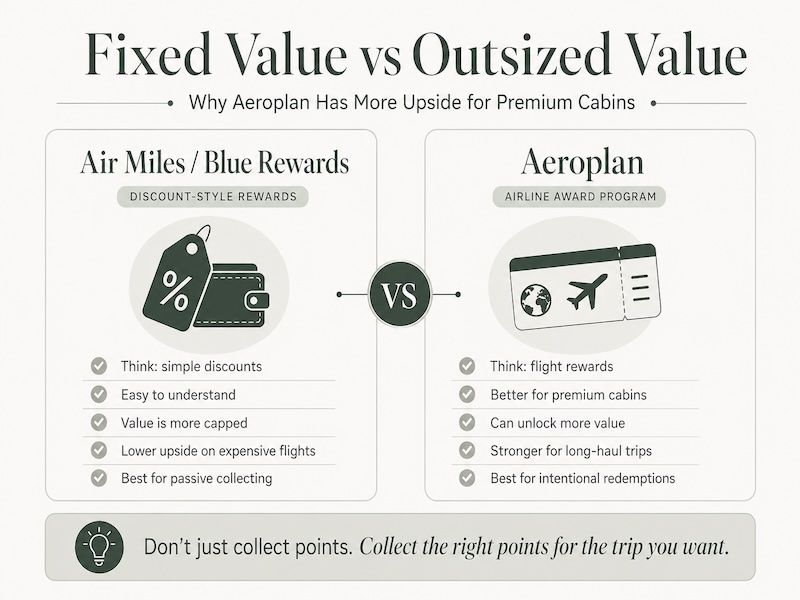
Air Miles still works more like a fixed-value rewards program than an airline award program.
That value can be useful.
But it is capped.
And that cap is the problem if your dream is business class to Europe, first class to Japan, or a lie-flat seat across the ocean.
With Air Miles, you are not really looking for sweet spots. You are not using an airline award chart. You are not turning a $9,000 flight into a redemption where the out-of-pocket cost feels almost ridiculous compared to the cash price.
You are earning a discount.
That can be fine.
It just is not the same thing as building a premium travel strategy.
What Is Aeroplan?
Aeroplan is Air Canada’s loyalty program, and for Canadians who want to use points for flights, it is usually one of the most important programs to understand.
Aeroplan points can be earned through Air Canada flights, partner flights, Aeroplan credit cards, the Aeroplan eStore, retail partners, hotel partners, and transferable credit card points programs.
Air Canada also has Star Alliance and other airline partners, which gives Aeroplan more flight redemption potential than a closed retail rewards program.
This is where Aeroplan becomes structurally different from Air Miles.
Aeroplan is not just a retail rewards program.
It is an airline loyalty program with access to award flights.
That matters because the cash price of a flight and the points price of a flight do not always move together.
A business class ticket might cost thousands of dollars in cash, but it may be bookable for a much smaller number of Aeroplan points if you understand the program, the route, the partners, and the availability.
That gap between the cash price and the points price is where the real value lives.
This is why Aeroplan can make sense for premium travel in a way Air Miles does not.
Aeroplan is not perfect. Award availability can be frustrating. Air Canada dynamic pricing can make some routes expensive in points.
Some partner bookings have taxes, fees, or surcharges that are a bit much — in my opinion, hello Emirates. And like every loyalty program, Aeroplan can change over time.
But if you are a Canadian trying to build toward premium cabin travel, Aeroplan is usually the foundation I would start with.
Not because everyone should collect Aeroplan blindly.
Because for premium international flights, Aeroplan has the structure, airline partners, and redemption options that can actually get you there. You are not limited to Air Canada flights, which is a big part of why the program can be so useful.
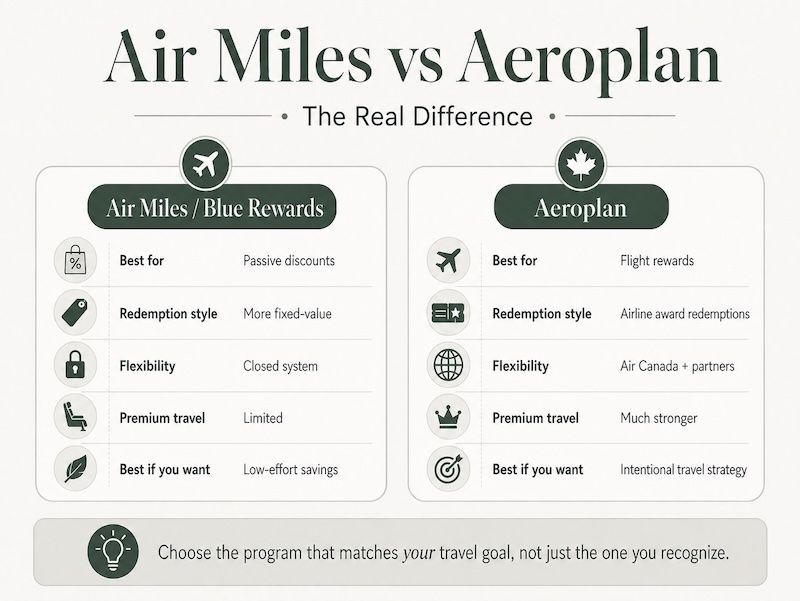
Air Miles is built for everyday rewards and fixed-value-style redemptions.
Aeroplan is usually used most efficiently when you book award flights, which are flights booked with points, and leverage airline partners.
That distinction matters more than anything else.
If you want a small discount from shopping you were already doing, Air Miles may be fine.
If you want to use points for premium cabins, Aeroplan is the program with the better structure.
This is the mistake I see people make all the time.
They collect points because a program is familiar. They join everything. They swipe every card. They let points scatter across six different accounts.
Then, when they finally want to book something meaningful, they realize none of those balances are large enough or flexible enough to get them where they actually want to go.
That is not a strategy.
That is how you end up with a bunch of points and nothing meaningful to book.
Earning Points: Retail Habits vs Travel Strategy
Air Miles is mainly built around partner retailers.
You earn by shopping with participating brands, using offers, scanning receipts, booking through the Air Miles travel options, shopping through the Air Miles eStore, and using eligible BMO Air Miles cards.
That can work well if you shop regularly with Air Miles partners.
But it can also be slow.
And if the earning is slow, scattered, and not tied to a trip you actually want, it becomes very easy to stop caring.
This is the part people do not always want to hear: a program being free to join does not mean it is worth your attention.
Yes, it is free to swipe.
Yes, you might eventually get something.
But attention is also a cost.
What I have seen with clients is that when people collect too many random rewards programs, they get overwhelmed.
They forget which points they have.
They forget where they earn.
They forget to redeem before the value becomes irrelevant to them.
But when they focus on specific programs that are tied to a real travel goal, they are more likely to stay engaged.
They remember the program because the program is getting them something they actually care about.
Aeroplan earning is more travel-strategy focused.
You can earn Aeroplan points through co-branded credit cards, Air Canada and partner flights, the Aeroplan eStore, retail partners, and transferable points programs.
That gives you more ways to intentionally build toward a flight redemption instead of slowly accumulating a scattered balance from occasional retail swipes.
This is why I do not want beginners chasing every program.
I want them asking:
What trip am I trying to book, and which points actually help me get there?
Redemption Value: Discount Program vs Premium Travel Potential
This is where Air Miles vs Aeroplan becomes very clear.
Air Miles has value, but that value is limited.
If you are using points as a discount against a cash price, then a very expensive flight still requires a very expensive amount of rewards.
That is not how premium cabin sweet spots usually happen.
When I say “sweet spot,” I mean a route or redemption where you can regularly find strong value for your points. For example, Montreal to Germany is a route where I often find business class availability around 60,000 points, which can be low compared to cash prices that retail for thousands of dollars.
Aeroplan is different because Aeroplan points can be used for flight rewards with Air Canada, Star Alliance airlines, and other airline partners.
That partner access is what creates opportunity.
A cash ticket in business class might be wildly expensive.
But the points price may be much more reasonable if there is award availability and you know which partner to book.
That does not mean every Aeroplan redemption is amazing.
Some are bad.
Some are average.
Some are not worth your points.
But Aeroplan gives you the possibility of outsized value.
Air Miles does not really play that game.
And if premium travel is your goal, that possibility is the whole reason to bother learning points in the first place.
Premium Travel: Which Program Actually Gets You There?
I am going to be direct.
Air Miles is not the program I would use for premium travel.
It is not the program I would recommend to someone who wants business class to Europe, a lie-flat seat to Asia, or a premium cabin experience that would cost thousands in cash.
That is not me being dramatic.
That is just the structure of the program.
Air Miles is better understood as a passive rewards or discount program. You collect, you redeem, and eventually you may get money off groceries, merchandise, travel bookings, or other rewards.
That can be useful for some people.
But useful is not the same as powerful.
Aeroplan is the better fit for premium cabin travel because it has airline award redemptions, Air Canada access, Star Alliance partner access, and more opportunities to use points against flights where the cash price is high.
This is why I personally leave Air Miles behind.
It takes too long for what I want from a rewards program.
And if I am going to put energy into learning, tracking, earning, and redeeming points, I want that energy going toward programs that can actually get me the kind of travel I care about.
For me, that means Aeroplan.
Flexibility: Closed System vs Airline Partner Network
Air Miles is a closed system.
You cannot transfer Air Miles to Aeroplan. You cannot move them into airline partners. You cannot combine them with Aeroplan points when you are short for a flight.
That matters.
Because the moment you decide you want to book something specific, flexibility becomes everything.
Aeroplan is not transferable out to other programs either, but it has a much larger airline redemption ecosystem inside the program itself.
Air Canada is part of Star Alliance, which means Aeroplan points can connect you to far more flight options than a closed retail rewards program.
That does not make Aeroplan perfect.
But it makes it much more useful for the type of person who wants international flights, premium cabins, and more route options.
Air Miles asks you to stay inside Air Miles.
Aeroplan gives you access to an airline network.
And in travel rewards, more options are usually a very good thing.
What the Blue Rewards Rebrand Means for Air Miles Collectors
Air Miles is changing.
On June 1, 2026, the Air Miles program is expected to transition to Blue Rewards. Existing Air Miles balances will automatically convert to Blue Points with no action required and no loss in value.
Blue Points are expected to be available for redemption starting June 2, 2026. The conversion is not a simple “one Air Mile becomes one Blue Point” situation in terms of point count.
The better way to understand it is equivalent value.
Air Miles says AIR MILES Reward Miles will convert to Blue Points with no loss of value, and that 1,500 Blue Points will equal $10.
For example, 95 Air Miles currently equals $10, and under Blue Rewards, the comparable structure is expected to be about 1,500 Blue Points for $10.
BMO has also said current BMO Air Miles credit and debit cardholders can continue using their cards during the transition, with more card-specific updates expected.
So, should Air Miles collectors panic?
No.
Based on the current information, your balance is not disappearing. The value is meant to be maintained through the transition.
But should premium-travel-focused Canadians suddenly get excited about Blue Rewards?
Also no.
At least not yet.
The rebrand may make the program simpler. It may improve the app. It may add partners. It may be a better version of Air Miles.
But a better version of a fixed-value rewards program is still not the same thing as Aeroplan and other non-fixed-value rewards programs.
The issue with Air Miles was never only the name.
The issue was that it was not built for premium cabin redemptions, if that is what you are looking for.
Blue Rewards may become a better passive rewards program. I will update this post once the program is fully live and we can see how it actually performs.
But for now, if your goal is luxury cabins, Aeroplan is still where I would put my energy.
Should You Choose Air Miles or Aeroplan?
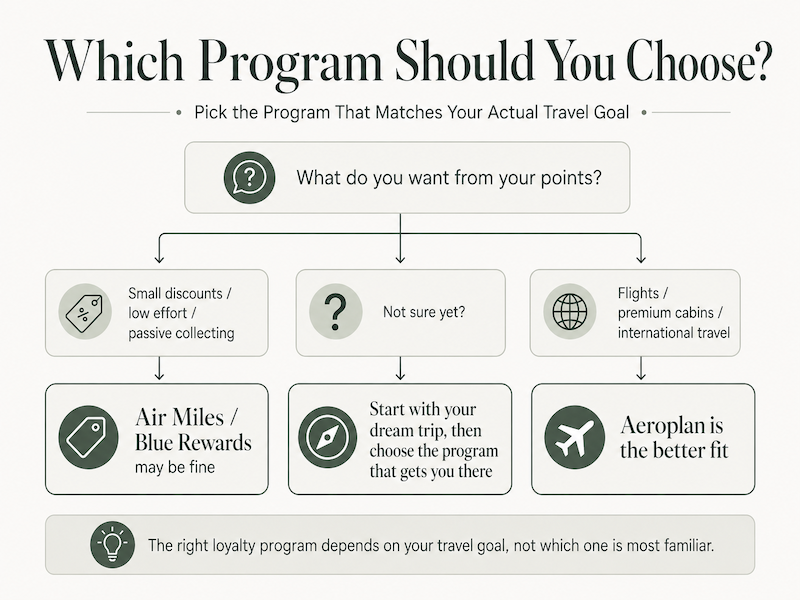
The answer depends on your goal.
Should You Choose Air Miles or Aeroplan?
If you want a simple program where you can collect passively and eventually redeem for a discount, Air Miles or Blue Rewards may be fine.
If you already shop with participating partners, remember to use the program, and do not care about maximizing for premium flights, there is nothing wrong with collecting.
But I would not go out of my way for it.
And I definitely would not let it distract you from a stronger points strategy.
If you want premium travel, choose Aeroplan.
Business class to Europe.
A lie-flat seat to Asia.
A long-haul flight where you arrive feeling like a human instead of spending the first two days recovering.
Those are Aeroplan goals.
Not Air Miles goals.
This is where I want you to be honest with yourself.
Are you collecting points because the program is familiar?
Or are you collecting points because they are getting you closer to a specific trip?
They are not the same thing, and being financially savvy means knowing the difference.
When Air Miles Might Still Make Sense
Air Miles is not completely useless.
It may still make sense if:
- you already shop with Air Miles partners
- you will not get overwhelmed by multiple programs
- you want a passive discount program
- you are not interested in premium travel
- you do not want to learn airline award redemptions
- you remember to use your Miles and do not let the balance sit forever
- you are comfortable treating it as a secondary or tertiary rewards program
That last point really matters.
Air Miles should not be the main program for someone who says they want luxury travel.
It can be a background program.
It can be a “sure, I’ll swipe if I’m already here” program.
I am all for that as long as it does not take away from your actual goals.
It can be a small discount program.
But I would not let it become the place where your best spending, attention, and strategy go.
If you only have so much mental bandwidth for points, use it where the upside is higher.
When Aeroplan Makes More Sense
Aeroplan makes more sense if:
- you want to use points for flights
- you want to travel internationally
- you care about premium cabins
- you want access to Air Canada and partner airlines
- you are willing to learn some redemption basics
- you want a program that can connect to a larger travel strategy
Aeroplan is not always the easiest program.
But it is the one I would rather see a beginner learn if their real goal is premium travel.
The learning curve is worth it because the potential outcome is better.
That is the difference.
Air Miles teaches you to collect slowly and redeem for something eventually.
Aeroplan can teach you to choose a destination, understand a route, earn the right points, and book a flight that would have been expensive in cash.
That is a strategy.
The Simplicity Argument
One of the biggest mistakes beginners make is thinking more programs means more rewards.
It usually does not.
More programs often means more confusion.
More logins.
More expiry rules.
More balances that are too small to use.
More “I think I have points somewhere, but I do not remember where” energy.
I do not want that for you.
What I have seen over and over again is that people are more likely to actually use their points when the points are attached to a clear goal.
When someone knows, “I am earning Aeroplan points because I want to fly business class to Europe,” they pay attention.
They check availability.
They understand why the card matters.
They care enough to learn the system.
But when someone is collecting Air Miles, Scene+, random hotel points, a little cash back, and three different bank currencies with no plan, they usually get overwhelmed and disengaged.
That is not a personal failure.
That is just too much noise.
It is also worth thinking about your spending power.
You can only put one purchase on one card, so dividing your everyday spending across too many programs can make it take longer to see meaningful results.
Think of your spending like water filling a bucket.
If you keep pouring a little bit into five different buckets, it takes much longer for any one of them to fill.
But if you focus on the bucket that gets you closer to the trip you actually want, you will usually see progress faster.
A good points strategy should make your travel goal clearer.
Not create another chore.
FAQs
Can You Use Air Miles for Flights?
Yes, you can use Air Miles for flights and other travel redemptions through the Air Miles travel options.
Under Blue Rewards, travel booking is expected to continue with a new program experience, though the actual value will depend on the program’s redemption structure once it is fully live.
But using Air Miles for flights is not the same as booking an airline award with Aeroplan.
With Air Miles, think of it more like using rewards toward travel.
With Aeroplan, you are using an airline loyalty program to book flight rewards.
That difference matters most when the cash price is high.
Can You Transfer Air Miles to Aeroplan?
No. You cannot transfer Air Miles to Aeroplan.
They are separate loyalty programs.
This is one of the main reasons I do not recommend building both programs equally if your goal is premium travel.
You cannot combine them when it matters.
Are Air Miles Worth Anything?
Yes, Air Miles are worth something.
The better question is not “are they worth anything?”
The better question is:
Are they worth your attention compared to other programs?
For premium travel, my answer is no.
Is Aeroplan Better Than Air Miles?
For premium travel, yes.
Aeroplan is better than Air Miles if your goal is flights, international travel, airline partners, or premium cabins.
Air Miles may be easier for passive retail rewards, but Aeroplan has a stronger structure for travel redemptions because it connects to Air Canada, Star Alliance, and other airline partners.
The programs are built for different outcomes.
Choose based on the outcome you actually want.
What Happens to My Air Miles When It Becomes Blue Rewards?
Your Air Miles are expected to automatically convert to Blue Points when the program transitions to Blue Rewards on June 1, 2026.
The conversion is expected to happen with no loss in value, and Blue Points should be available for redemption starting June 2, 2026.
You do not need to do anything for the conversion.
Just be aware that redemptions and account access may be unavailable on June 1 during the transition.
Should I Still Collect Air Miles if I Already Have Aeroplan?
Maybe, but I would not prioritize it.
If you are already at an Air Miles partner and it is effortless to collect, fine.
But I would not make Air Miles your main focus if your real goal is premium travel.
Every program you collect requires attention. Even free programs create mental clutter.
If Aeroplan is the program that gets you closer to the flight you actually want, focus there first.
The Bottom Line
Air Miles and Aeroplan are both well-known Canadian loyalty programs, but they are not built for the same purpose.
Air Miles can be fine for passive rewards, small discounts, and people who want something simple.
Aeroplan is the stronger program for Canadians who want to use points for flights, especially premium cabin travel.
That is the honest comparison.
Air Miles is not bad because it has no value.
It is limited because it is not built for the kind of travel many people imagine when they start collecting points.
And that is why I do not want you blindly collecting it just because it is familiar.
Your points should have a job.
If the job is “eventually get a small discount,” Air Miles may be enough.
If the job is “get me into a lie-flat seat across the ocean,” Aeroplan is the better place to start.
Do not spread yourself thin chasing programs that do not match your goal.
Pick the program that gets you closer to the trip you actually want, then build toward it with intention.
If you are not sure how many points you actually need to make your dream trip happen, the First Class Calculator takes the guesswork out of it. Plug in your destination and preferred cabin, and it will show you what you are working toward.
Download Now